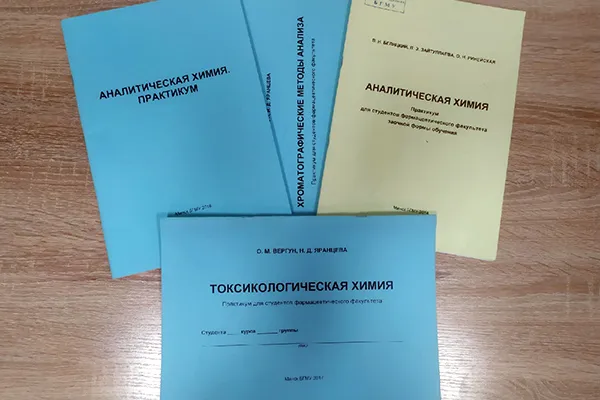
The Department of Pharmaceutical Chemistry with a course of advanced training and retraining is attended by 2nd-5th year full-time and 2nd-6th year part-time students of the Faculty of Pharmacy, as well as 2nd-5th year international students of the Faculty of Medicine majoring in Pharmacy with Russian and English as the languages of instruction.
Academic disciplines teaching of which is assigned to the department:
- "Analytical Chemistry";
- "Chromatographic methods of analysis";
- "Pharmaceutical Chemistry", 3rd and 4th year;
- "Toxicological chemistry";
- "Modern methods of analysis and standardization of medicines";
- "Pharmaceutical ecology";
- "Development and quality control of biotechnological products" (elective course);
For all disciplines, educational and program documentation has been developed and is constantly updated through amendments and additions.
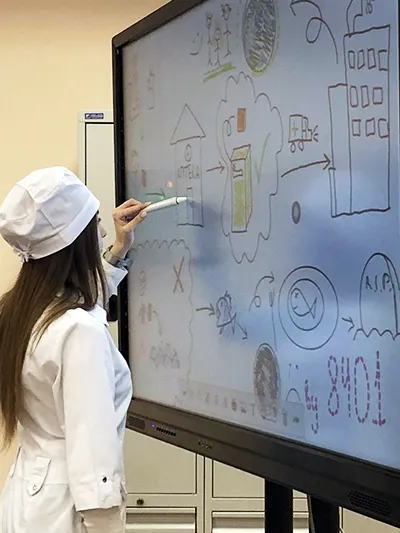
The Department has developed electronic teaching and methodological tools for the disciplines taught, including in English. Since 2020 video lectures have been recorded, facilitating student learning. Pharmaceutical chemistry classes emphasize the requirements of the State Pharmacopoeia of the Republic of Belarus for drug quality control, structure of the substances studied, and their relationship to pharmacological activity. To achieve this students need a solid foundation in normal and pathological human physiology, general pharmacology, biochemistry, organic chemistry, and general and inorganic chemistry. This focus can be further explored in clinical pharmacology and pharmaceutical care, thus ensuring the continuity of pharmaceutical education.
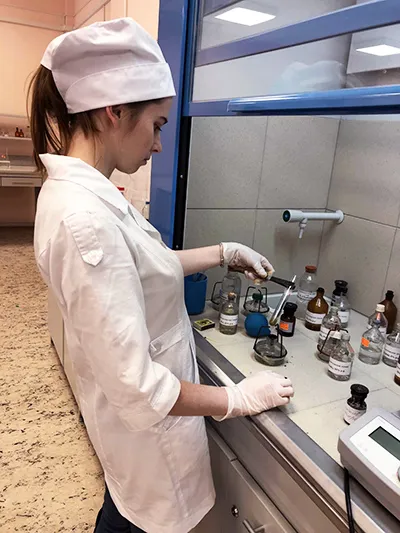
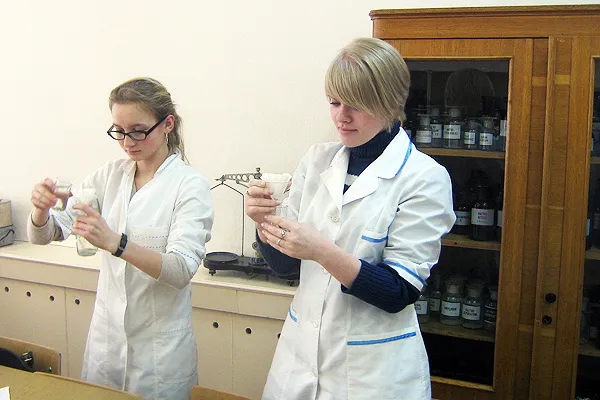
In all classes students complete laboratory works aimed at acquiring and reinforcing skills in the quality control of pharmaceutical substances and medicinal products. Students conduct qualitative and quantitative analysis of active pharmaceutical ingredients, rapid analysis of extemporaneous dosage forms, and master modern methods of drug analysis.
In the study of toxicological chemistry mineralization and steam distillation are carried out, and other methods for isolating toxic substances from biological material are also mastered. Issues of toxicokinetic and toxicodynamic, molecular mechanisms of toxicity, drug interactions with toxic effects, diagnostics, and approaches to treating the main types of poisoning (including drug poisoning) are studied, all of which are reflected in toxicological chemistry.
Students develop a foundation for chemical thinking in quality control issues through the study of analytical chemistry. This course covers not only theoretical foundations but also the current state and applied significance of chemical and instrumental analytical methods, the main components of analytical instruments and equipment, and fundamentals of titrimetric methods. A separate course is devoted to chromatographic analytical methods, which represent the most modern analytical methods and are constantly being improved allowing for the continuous expansion, updating, and supplementation of the curriculum.
Issues of quality control of medicinal products at all stages of circulation of medicinal products are generalized in the study of standardization of medicinal products, where the issues of control, provision and management of the quality of finished and intermediate products, raw materials in pharmaceutical production, in control and analytical laboratories are considered.
When studying pharmaceutical ecology, issues of medical and pharmaceutical waste disposal are considered at the legislative level, as well as using new technologies and scientific approaches.
The Department of Pharmaceutical Chemistry with a course of advanced training and retraining is a graduate specialized department where diploma theses are completed on current issues in pharmaceutical science.
Pharmaceutical chemistry, modern methods of analysis and standardization of medicines are included in the integrated state exam in pharmacy. Department staff supervise pharmacy interns and participate in the Qualification Exam for pharmacist interns.
The Department has a dedicated analytical internship program, which takes place in first-category pharmacies or analytical laboratories. For two weeks students practice in the workplace of a pharmacist-analyst performing various operations related to the quality control of medicines, pharmaceutical substances, and their documentation. In the 2023/2024 academic year an electronic internship diary was developed and tested along with a differential assessment system consisting of an objective structured exam and an oral interview regarding the diary.
To improve quality of the educational process mutual visits to lectures and labs have been introduced followed by discussions at department meetings. This is especially relevant for young faculty members learning the fundamentals of teaching.
The Department's staff has prepared a database of test questions, problems, and formulas, and updated list of drugs studied in line with modern pharmaceutical advances in the development of new molecules and new drugs in the pharmaceutical market of the Republic of Belarus and worldwide. Workshops and manuals are also published.
In the 2023/2024 academic year checklists were developed for monitoring and assessing practical skills in the academic disciplines assigned to the department, as well as multidisciplinary practical skills assignments for the state exam.
A collection of practical skills has been prepared for pharmacists-specialists when passing the qualification category exam.
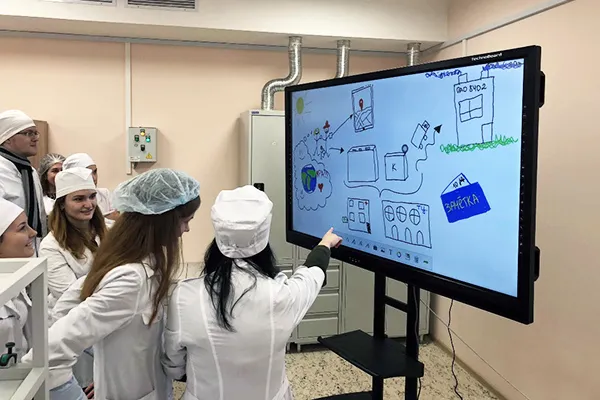
In addition to refresher courses, as groups are formed, training is organized within the framework of training courses for specialists with higher pharmaceutical education and teachers of educational institutions of the healthcare system.
Currently, the Department offers advanced training courses for managers and deputy managers of pharmacies and other organizations engaged in pharmaceutical activities, specialists with higher pharmaceutical education, and educators at healthcare institutions in three areas:
1. Quality system management in the development and circulation of medicines
2. Organization of the development and circulation of medicines in accordance with GxP (Good Pharmaceutical Practice) requirements
3. Instrumental and chemical quality control methods in pharmacist activities
In addition to continuing education courses, training is organized as groups are formed within the following training courses:
Pharmaceutical Chemistry (for authorized representatives of drug manufacturers)
Analytical Chemistry (for authorized representatives of drug manufacturers)
Toxicological Chemistry (for authorized representatives of drug manufacturers)
Structure, Efficacy and Safety of Over-the-Counter Medicines (for specialists with higher pharmaceutical education, teachers of educational institutions in the healthcare system)
The Importance of a Pharmaceutical Quality System for Drug Standardization (for specialists with higher pharmaceutical education, pharmacist-analysts, teachers of educational institutions in the healthcare system)
Regulation of Medical and Pharmaceutical Waste Management (for managers and deputy managers of pharmacies and other organizations engaged in pharmaceutical activities, structural and/or separate divisions, specialists with higher pharmaceutical education, pharmacists-organizers and teachers of educational institutions in the healthcare system)
Management of Development of Original and Generic Drugs (for managers and deputy managers of pharmacies and other organizations engaged in pharmaceutical activities, specialists with higher pharmaceutical education and teachers of educational institutions in the healthcare system).