
The main goal of educational and methodological work at the Department of Epidemiology is to create conditions that improve the educational process quality and efficiency.
Methodical work at the department is a set of activities aimed at:
- organization, implementation and improvement of the educational process (lectures and practical classes);
- development of educational and program documentation (educational standards, curricula);
- preparation of educational and methodological literature (methodological developments, educational and training manuals, textbooks);
- providing the educational process with electronic educational and methodological complexes;
- providing the educational process with didactic materials (situational tasks, tests, visual aids, posters, slides, presentations);
- improving the forms of current and final students’ assessment;
- improvement of the rating system for assessing the educational achievements of students;
- introduction of innovative teaching forms and methods in the educational process;
- improving the students practical training (mastering practical skills and abilities, classes in the Centers for Hygiene and Epidemiology, ect.);
- improving academic discipline, the independent work of students and the system of working off missed classes;
- improving the academic stuff pedagogical skills;
- development of the educational process with foreign students in English;
- development of educational and research work of students;
- improving the subject matter and content of elective courses;
- improvement of all forms, types and methods of educational work at the department, taking into account the state and prospects for the development of the sanitary and epidemiological service of our country.
The following disciplines are taught at the Department of Epidemiology:
- Epidemiology
- Pharmacoepidemiology
- Evidence-based medicine
The educational process planning and organization at the Department of Epidemiology is carried out in accordance with the Educational standards of higher education of the first stage, standard curricula and curricula of academic disciplines in the following specialties:
- 1-79 01 03 Preventive Medicine
- 1-79 01 01 General Medicine
- 1-79 01 02 Pediatrics
- 1-79 01 07 Dentistry
- 1-79 01 08 Pharmacy
Traditionally, Epidemiology is one of the fundamental disciplines at the Preventive Medicine Faculty. Theoretical knowledge and practical skills on Epidemiology are necessary for graduates of this faculty for independent professional activities aimed at preventing infectious diseases. Students of other faculties comprehend epidemiological knowledge in the amount necessary and sufficient to ensure the epidemic safety of all types of medical and diagnostic activities.
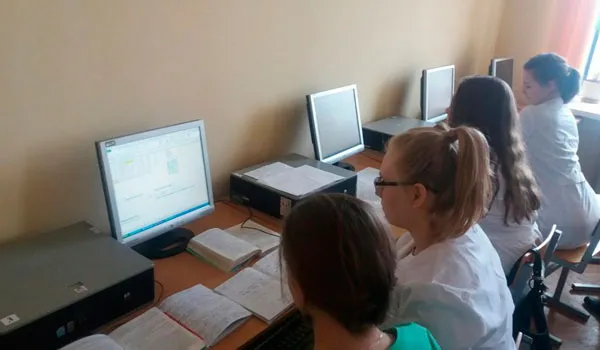
The development of information technology has significantly influenced on Epidemiology in general and the teaching of this discipline in particular. First of all, information technology progress has raised epidemiological diagnostics to a new level. The use of computers makes it possible to create databases on the infectious diseases incidence, choose rational methods for processing the material, present it in the form of computer tables and graphs, process data and formulate a conclusion (epidemiological diagnosis). Students acquire necessary skills on working with computer programs «Immunoprophylaxis» and «AIS-epidemiology». The «AIS-epidemiology» program includes subsystems:
- collection, accounting and storage of information;
- processing and analysis of information;
- epidemiological diagnosis;
- epidemiological forecast;
- control of management decisions;
- preventive and anti-epidemic measures.
The joint well-coordinated work of the Department of Epidemiology with the Centers for Hygiene and Epidemiology contributes to an increase the practical training of students of the Preventive Medicine Faculty. In the Centers for Hygiene and Epidemiology, under the guidance of experienced epidemiologists, students participate in the examination of epidemic foci, monitor the anti-epidemic regime in preschool institutions, schools, outpatient clinics, perform scientific and practical work.
Much attention is paid to improving the topics and content of elective courses. The subject of elective courses corresponds to the modern directions of improving the anti-epidemic support of the population: «Modern issues of immunoprophylaxis», «Basics of evidence-based medicine», «Fundamentals of Infection Control in Healthcare Organizations».
In recent years, the staff of the Department of Epidemiology has been constantly working on the creation and maintenance of electronic educational and methodological complexes, which are a high-tech didactic tool, ensures the continuity and completeness of the learning process, contains organizational and systematized theoretical, practical, control materials based on the principles of interactivity, adaptability, information openness. Electronic educational-methodical complexes enable the student to independently most flexibly use the proposed educational information in accordance with their individual abilities.
The teachers of the Department of Epidemiology published five textbooks with the stamp of the Ministry of Education of the Republic of Belarus. Over the past five years, about 30 educational programs have been developed and approved in the disciplines taught at the Department of Epidemiology, including the new discipline («Pharmacoepidemiology»).