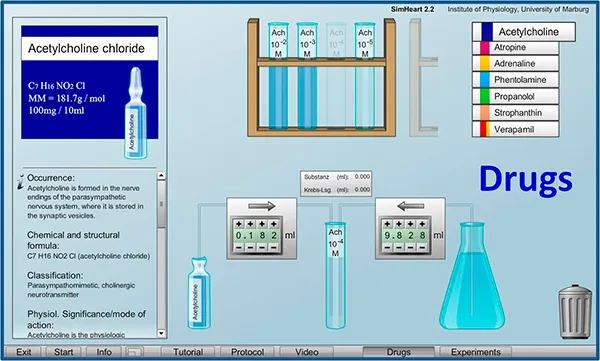
The Department of Pharmacology is constantly looking for and developing new innovative technologies and teaching methods, testing them, choosing effective options and introducing them into the educational process.
Information Products
A separate course “Pharmacokinetics”, including 4 lectures and 3 practical sessions (created by Professor Boris Dubovik). For the first time it was created and introduced into the educational process on the territory of the post-Soviet space. A complete informational support of the course, exercises of clinically oriented content for calculating the optimal dosage regimes for drugs, training tasks for correcting the dosage regimen in pathological conditions that change the pharmacokinetics of drugs have been developed.
Methodological aids of information and educational content for practical exercises, which form an integral pattern of key knowledge in all sections of pharmacology, including certain groups of drugs. The following teaching aids in English have been published and introduced into the educational process over the past years:
- General Prescription
- Pharmacology: Tests for the specialty “General Medicine”.
- Pharmacology: Tests for the specialty “Pharmacy”.
- Pharmacology: Tests for the specialty “Dentistry”.
Multimedia presentations of lectures using dynamic electronic modeling of the studied processes and phenomena.
Annually updated workshops for independent work of students:
- Pharmacology: Study Guide for the specialty “General Medicine”.
- Pharmacology: Study Guide for the specialty “Pharmacy”.
- Pharmacology: Study Guide for the specialty “Dentistry”.
Study guides contain:
- Study questions to prepare for each practice session.
- Annually updated classifications of medications.
- Tasks for practicing and improving practical skills: calculating an individual dosage regimen for medicines, tasks for issuing doctor's prescriptions, tasks for finding and studying trade names of medicines registered in the Republic of Belarus (for the specialty “Pharmacy”).
- Examples of prescriptions for various dosage forms.
- Questions for the final lessons in various thematic sections, as well as exam questions.
- List of literature for self-training of students.
- Regulatory documents and references related to medicinal products.
- Thematic plan of lectures and practical lessons.
- Electronic scalable visual aids for hands-on labs.
Constantly updated and supplemented electronic educational and methodological complexes intended for distance learning:
- Pharmacology for specialty “General medicine”.
- Pharmacology for specialty “Dentistry”.
- Pharmacology for specialty “Pharmacy”.
Each complex consists of several sections: general prescription, general pharmacology, particular pharmacology, blocks of normative and reference information.
Knowledge control
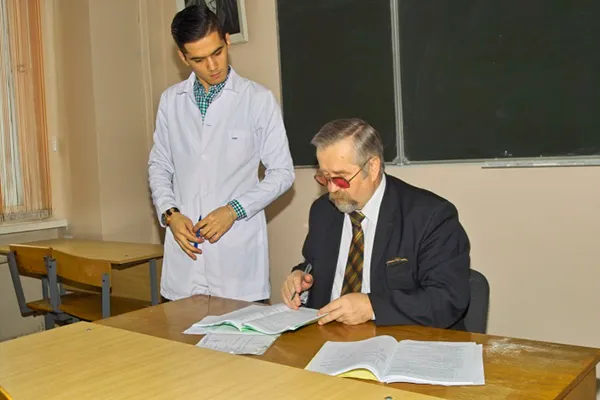
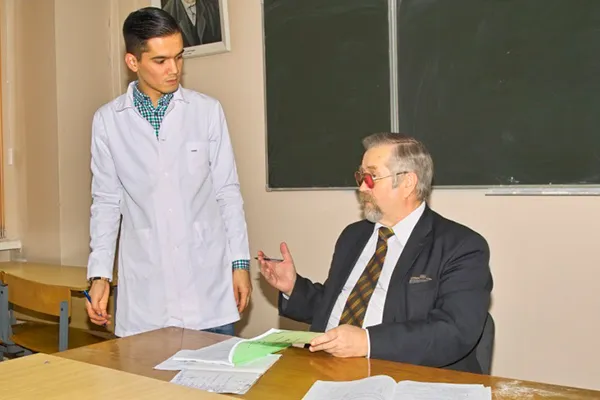
Monitoring of the educational process is carried out throughout the year at the final sessions of each cluster of disciplines:
- “General Pharmacology”
- “Pharmacology of the peripheral nervous system”
- “Pharmacology of executive organs and systems”
- “Pharmacology of the central nervous system”
- “Pharmacology of metabolic and immune disorders”
- “Chemotherapeutic drugs”
Final control of knowledge is carried out in two stages:
- credit lesson based on the results of students' work during the semester (using the electronic database of tests);
- an oral exam on a ticket, which includes 3 theoretical questions from various sections of pharmacology, and practical tasks: solving the problem of calculating an individual dosage regimen (for the specialty “General Medicine”), writing 2 prescriptions.
Promising developments
- Implementation of interactive teaching technologies on the basis of the educational and information center of the Department of Pharmacology using multimedia teaching aids, audio and video materials, Internet resources.
- Electronic “silabus” for the lecture course of the discipline.
- “Virtual laboratory of pharmacology” for studying the pharmacological effects of drugs, their combinations and dose patterns of action.