Brilliant Minds: Showcasing the Extraordinary Talents of Students
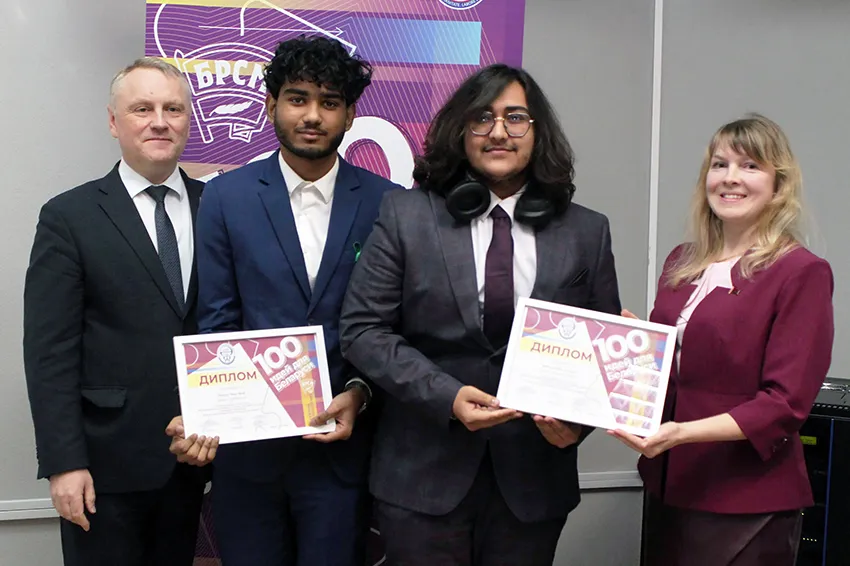
Chanul Yaneth Thennekoon from Sri Lanka and Krish Jignesh Lightwala from India are really outstanding students. Their interest in medicine, intellectual curiosity, high research potential, innovative thinking, strong programming skills, allow them to apply a creative, multidisciplinary approach to the study of current topics. Their exceptional abilities, dedication and pursuit of deep knowledge enabled them to achieve fantastic results in their researches. Chanul and Krish completed four research projects, which received four awards at the National student research competition. Our talented students got one 1st category Diploma, two 2nd category Diplomas, and one 3rd category Diploma.
The first project was called “PharmaBioPro: Bridging the Gap Between Pharmacology and the Human Microbiome – A New Integrated Platform for Personalized Medicine”. It is a software platform that can analyze medicines interactions with the intestinal microbiome. The PharmaBioPro platform concept includes four key modules: a curated intelligent knowledge base on medicine-microbiome interactions; a clinical workflow integration module for risk assessment and case management; a research center for study management; and a diagnostic module for laboratory technicians. This structure provides a comprehensive solution for the implementation of pharmacomicrobiomics in clinical practice.
Their second project was called “Vaxispace Advanced: a Comprehensive Theoratical Framework for the Multiscale Immunological Interaction Modeling”. This is a platform for modeling the interplay between vaccination-induced immunity, pathogen evolution, and population-level immunological dynamics to determine the level of active immunity of individuals post vaccination after a set period of time.
A personalized immunity assessment system quantifies the impact of HLA genetics, comorbidities, and lifestyle. The geoimmunology module provides global visualization of immune status, identifying vulnerable regions with immune coverage below 60%. Pathogen evolution algorithms simulate mutational pressure, predicting the potential emergence of variants based on selective immune pressure. The developed platform provides a comprehensive theoretical and computational basis for multiscale modeling of the immunity-vaccine-pathogen ecosystem. It enables the transition from population-based to personalized immunity prediction and creates a powerful tool for vaccination planning.
The third project was called “Thrombo-AI: an Integrated Platform for Predicting Thrombosis Risk and Optimizing Anticoagulation Therapy”. It is a platform with a dynamic, multi-dimensional, and personalized evaluation using computational power and artificial intelligence for prediction and analysis of thrombus formation.
A key achievement of this work is the platform's ability to identify high-risk patients systematically missed by traditional assessment.
Their fourth project was called “COR-VIDENS: an Integrated Platform for Predicting Cardiovascular Disease Prevention and Overuse Costs”. Conventional diagnostic approaches in cardiology often delay diagnosis and compromise treatment of cardiovascular diseases. An integrated platform was introduced, which is incorporating 18 validated scales and algorithms covering 6 core domains: chronic heart failure, valvular heart disease, acute coronary syndrome, atrial fibrillation, thromboembolism, and general cardiovascular prevention.
The predictive cardiology platform employs a three-tiered strategy: diagnostics using machine learning; risk stratification with automatic calibration of weighting coefficients for ethnically diverse populations, personalized therapy recommendations accounting for 23 clinical and laboratory parameters. The platform demonstrates high accuracy and calculation transparency, promoting standardization of treatment.
In their scientific research, Tennekun Chanul Yanet and Laitwala Krish Jignesh have proven themselves to be responsible, disciplined, hardworking, and diligent students and researchers. Beyond the classroom, Krish and Chanul are active in many ways. Their paths to medicine were different, but very exciting.
Krish Laitwala became interested in medicine when he was 15. His mother always wanted to be a doctor but couldn’t, so she encouraged him to become one. That’s why he want to be a good doctor – for her.
Krish didn’t go to school regularly because he was often sick. But he still learned a lot outside school. He went to summer programs at Coventry University and Cambridge University in the UK. At school, he once made a simple diabetes model. He also loved building things like Arduino and Raspberry Pi projects.
He started learn programming after attending a class about BBC Microbit. He got interested and began learning online through Udemy. Later, he joined a coding summer program at Cambridge. His biggest achievement in this area is getting the OSDA certification in cybersecurity, which is very tough to earn. It was very challenging, but it taught him to never give up and to keep learning – which will help him in medicine too.
In his free time, he helps his father in his company. He likes doing accounting, checking finances, and learning about business laws. It’s like a hobby for him. Managing skills taught him how to lead people, plan things, and take responsibility – all useful skills for leading a hospital team.
In the future, Krish wants to become an oncologist. He is most interested in using technology for early detection and personalized treatment of cancer. He feels his skills in programming and business will help him create medical software and manage a team well in the future. He thinks he can use his tech skills to make software that helps in cancer research and treatment. His business experience will help him lead a team smoothly and run things efficiently.
Chanul’s Tennekun interest in medicine was ignited during his school years, but it transformed from a fascination into a profound calling in the 5th grade. This shift was deeply personal: his father had to undergo a high-risk heart surgery. Witnessing the anxiety, the hope, and ultimately the skill of the medical team that saved his father's life left an indelible mark on him. He wanted to understand the science behind such miracles and, one day, be the one providing that hope to others.
From that point, his fascination with biology and chemistry took on a new urgency. He wasn't just learning about the human body at a molecular and systemic level. Participating in science fairs and voraciously reading about medical breakthroughs – especially in fields like cardiology, immunotherapy, and genomiсs solidified his desire to pursue a career where he could contribute to healthcare innovation and pay forward the gift his family received.
Chanul’s journey into the digital world began with structured academic training. He laid the core foundation for his programming skills during his two-year O-Level program at Stafford International School in Sri Lanka. The rigorous computer science curriculum there provided his first formal exposure to computational thinking, problem-solving with code, and software development principles. This foundational period was crucial, giving him the discipline and core knowledge upon which he could build. He also explored tutorials and courses on platforms like Coursera and edX, focusing particularly on Python due to its growing importance in data analysis and bioinformatics. This powerful combination – a strong formal foundation from Stafford and targeted self-directed learning – gave him a robust and versatile skill set.
Chanul completed his primary and secondary education in Sri Lanka, where he focused on the biological sciences stream. This included in-depth study of biology, chemistry, physics, and mathematics, while also being one of the youngest graduates graduating at the age of 15, which prepared him for higher education in medicine. He also participated in extracurricular activities like debate clubs and science societies, which helped develop his analytical and communication skills.
Chanul learned about Belarus and the Belarusian State Medical University through extensive research while exploring international medical education opportunities. BSMU’s reputation for high academic standards, affordable tuition, and globally recognized programs (particularly in English) stood out. He also consulted with educational advisors, connected with alumni, and reviewed the university’s partnerships with international medical institutions, which reinforced his decision.
Outside of academics, he enjoys activities that balance his mind and creativity. Chanul’s hobbies include reading scientific journals and historical fiction, playing the guitar, hiking, and experimenting with coding projects related to healthcare domain. He also enjoys learning about different cultures, languages and developing new skills, which aligns with his experience as an international student.
In the future, Chanul envisions himself as a surgeon specializing in neurosurgery. He aims to integrate clinical practice with research, leveraging programming skills to work on projects involving medical data analysis, AI-driven diagnostics, or personalized medicine. Ultimately, he hopes to contribute to making healthcare more precise, accessible, and innovative.
Krish and Chanul are very responsive to other people's troubles. The above-named students volunteer, helping an orphanage.
In November 2025, two research projects were successfully presented by Krish Jignesh Lightwala and Chanul Yaneth Thennekoon at the university stage of the "100 Ideas for Belarus" competition. This was the first time in the history of the Belarusian State Medical University that students from the Faculty of Medicine for International Students have done so.
Krish’s and Chanul's 18 publications on electronic platforms and in collections of scientific papers, successful participation in international conferences:
- VII International Research Competition “BEST SCIENTIFIC PROJECTS AND RESEARCH 2025”;
- X International Student Research Competition “STUDENT SCIENCE: BEST RESEARCH AND DEVELOPMENTS 2025”;
- XII International Scientific-Practical Conference “YOUNG RESEARCHER 2025”;
- XIII International Scientific-Practical Conference “WORLD OF SCIENCE”;
- Student and Young Scientists Research and Practical Conference “Innovations in Medicine and Pharmaceutics – 2025”.
The results of their research were awarded 6 1st degree Diplomas, 4 2nd degree Diplomas and 2 3rd degree Diplomas, confirm the recognition of their achievements. The international scientific activities of the Faculty of Medicine for International Students contribute to the enhancement of the Belarusian State Medical University's image.
Highligthting the gifts of talented students Krish Jignesh Lightwala and Chanul Yaneth Thennekoon, the Faculty of Medicine for International Students warmly congratulates them and their families on their scientific achievements, is proud of them both, and expresses confidence that in the near future Krish’s and Chanul's names will be among the leading scientists in the field of medicine.
Zhanna Shaban, academic supervisor, PhD, associate professor of the Department of Microbiology, Virology, Immunology;
Elena Devina, PhD, Deputy Dean of Medical Faculty for International Students
Photos provided by the authors
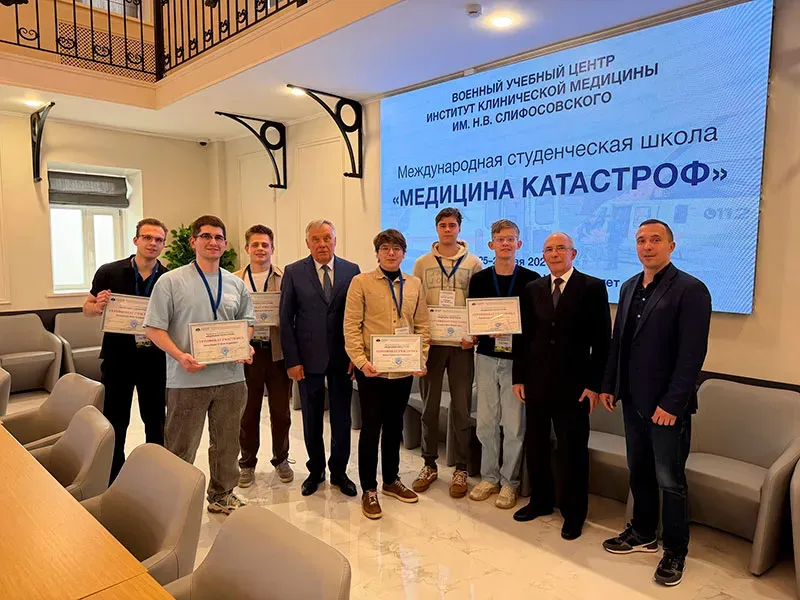
BSMU students took part in the International Student School of Disaster Medicine
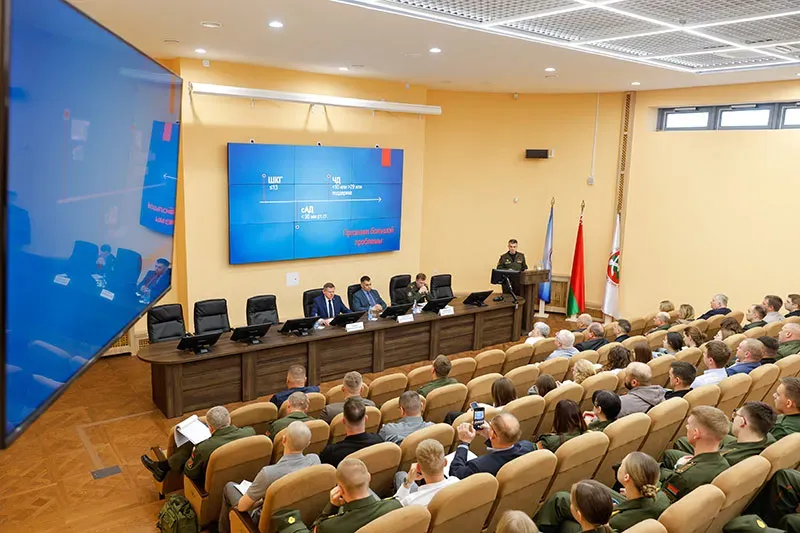
Republican scientific and practical conference with international participation "Current issues of military medicine"
High level of cooperation: BSMU received an honorary delegation from Azerbaijan
Xth National Congress with International Participation "Parinsky Readings 2026"