
The Department of Public Health and Healthcare of BSMU is closely related to practical healthcare and provides education to students from all faculties of our university. The history of our Department has 97 years.
Public Health and Public Health is a science that studies the theoretical basis and organizational principles of health care, taking into account the historical experience and current state, the regularity of public health and the factors that determine it.
The traditions established during its existence by the staff of the Department - outstanding scientists in the field of health organization and history of medicine: M.I. Barsukov, D.P. Belyatsky, G.R. Kryuchny, K.N. Anishchenko, M.K. Zubritsky, N.N. Piliptsevich - are carefully preserved today.
In 1924, Department of Social Hygiene and Public Health Management was opened as part of the Medical Faculty of the Belarusian State University - the first Department of this profile on the territory of Belarus.

The People’s Commissioner of Health of the BSSR Mikhail Barsukov (1924-1930) was appointed to the post of head of the department. Zachary Frankel, a professor, Head of the Department of Social Hygiene of the Leningrad Institute of Advanced Medical Education (1924-1953) was seconded to help new created department for the first lectures on social hygiene. It was initiative of the People’s Commissioner of Health of the RSFSR (1918-1930), Professor and Head of the Department of Social Hygiene of the Medical Faculty of Moscow University (1921-1949) Nikolai Aleksandrovich Semashko.
From the first days of its existence, the Department of Social Hygiene of the Belarusian State University set one of the leading tasks to train and educate young doctors - organizers of health care.
M.I. Barsukov involved students as contemporaries and accomplices of events taking place in the health care of Belarus during their studies.
A book fund was established at the Department, and teaching staff developed educational and methodological tasks for practical exercises and visual teaching aids. Future physicians were able to quickly obtain first-hand information about developments in the health care, preparing themselves for future work in a purposeful, state-of-the-art way.
The courseware included a large section on prevention, teaching about the disease as a social and biological phenomenon and provided for a broad interpretation of a number of problems: working conditions, everyday life, family problems (protection of motherhood and infancy, social education), social anomalies, social illnesses (tuberculosis, venereal diseases, nervous disorders).
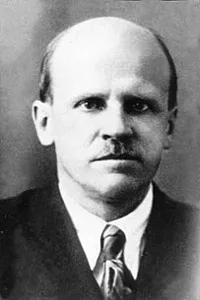
Social hygiene was taught to fifth-year students. In order to consolidate students' knowledge M.I. Barsukov initiated a project on the work placement internship of students as an organic part of the educational process. He was the first to recommend to lead a six-year educational course of study for doctors. He offered a one-year internship in hospitals after graduating from medical school. The issues of educational reform were presented in the article 'The Main Ways of Developing Medical Education in BSSR' (1928).
In 1927 the discipline «Social Hygiene» was introduced as a state exam.
M.I. Barsukov scientific works as well as other teaching staff of the Department works had a pronounced socio-hygienic orientation. They have played a major role in the development of the theoretical foundations of Public health and Health care.
Apart from the development of theoretical and organizational problems of health care, M.I.Barsukov and the first teaching staff of the department (S.R. Dikhtyar, S.N. Efimov, B.J. Smulyovich, D.L. Eingorn) conducted an in-depth study of the health of the population of Belarus and the influence of various factors on it.
The fundamental study of the Assistant Professor B.J. Smollevich 'Morbidity and Mortality of the Population of the City and Suburbs of the BSSR'(1928) was highly praised by specialists both in our country and abroad. It has not lost its scientific and educational significance till now.
Barsukov unique organizational talent contributed to the successful solution of a wide range of Public health and population health problems of the population and to bringing the topic closer to the needs of the developing republic’s health care.
Statistical processing was carried out on the basis of the Department: Institute of Social Hygiene and Clinic of Occupational Diseases were functioning at the Department. In retrospect, these studies have laid the groundwork for a comprehensive study of the health of the population, which is now classic in the study of chronic non-epidemic diseases.
After moving M.I. Barsukov to Moscow from 1930 to 1941, Professor David Vladimirovich Lifschitz headed the Department. The professors of the Department were A.D. Gorbach, G.A. Duhan, N.A. Saevich.
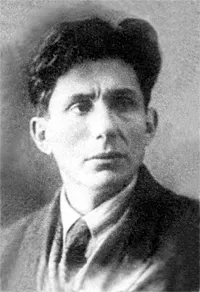
During this period, the programme of the social hygiene course was gradually modified, with the expansion of the sections on the organization of health care for the population, justification of new organizational forms for the activities of health-care institutions in connection with industrialization and collectivization in the Republic and development of a system of indicators for evaluating the activities of treatment and preventive establishments.
Since 1937, there has been a Post-graduate Training at the Department. In 1937, Doctor Nina Aleksandrovna Saaevich was the first Post-graduate Training student. Later she became a major scientist, Head of the Department of Preventive Care for Children and Mothers of the Ministry of Health of the BSSR (1943-1955), Chief Paediatrician of the Ministry of Health of the BSSR (1951-1961), Head of the 2nd Pediatrics Department of the Belarusian Institute of Advanced Medical Education (1961-1974).
In May 1941, by the order of the People’s Commissariat of Health Care of the USSR, the Department of Social Hygiene was renamed as the Department of Health Care. But the Great Patriotic War (1941-1945) made significant changes in the activity of the medical institute and, accordingly, the department. During the war, all the property of the department was lost.
In 1943, the work of the Institute in evacuation in Yaroslavl was resumed. The Institute was opened in Yaroslavl. The Chair of Health Organization at such a difficult time was headed by Assistant Professor Anna Abramovna Lipmanova.
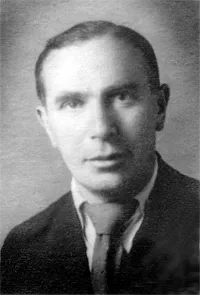
After the return of the Institute from evacuation in the first year of study (1944-1945), Grigory Abramovich Duhan was appointed as the Head of the Department of Health Care.
The training took place in difficult conditions: there were not enough staff, classrooms, textbooks, visual aids, fuel and light. It has been necessary to address all these shortcomings and, at the same time, to constantly improve the quality of students' education.
From 1945 to 1978 Professor Dmitry Pavlovich Belyatsky was Head of the Department Doctor of Medical Sciences, - the leading representative of the Belarusian Scientific School of Social Hygienists.
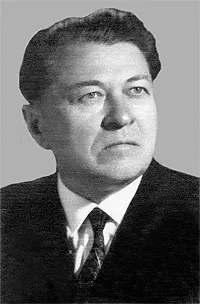
A study of the health consequences of the war, an analysis of the health damage caused by the German-Fascist occupation and its impact on the morbidity of the population was initiated.
D.P.Belyatsky scientifically justified the program of sanitary and epidemic control measures, which made it possible in a short period of time to eliminate typhoid fever as a mass disease, to ensure a reduction of other infectious diseases. He was a deputy of the People’s Commissariat of Health Care - Chief State Inspector of the BSSR (1945-1959) and head of the Department of Social Hygiene and personally headed the work on its realization in the republic.
In 1951, the Department of Health Care was renamed as the Department of Health Care and History of Medicine. This led to the establishment of a course on the history of medicine at the Department. The main part of scientific research activity of the Department becomes generalization of historical experience of development of health care and medicine of Belarus.
The Department conducted extensive analysis of archival materials, collections of libraries, works of painting, sculpture, architecture, visited exhibitions of museums around the world, worked with relatives, eyewitnesses of events, specialists-historians, etc.
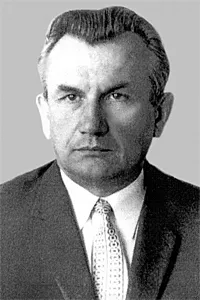
In 1958 G.R. Kryuchok and the group of employees of the department were prepared the first large photo documentary exhibition «History of the Minsk State Medical Institute». The Commission on the reception of the photo exhibition in its resolution noted that the exhibition «should be an initial stage in the creation of the museum of the history of medicine and health care of the BSSR».
At the end of 1965, the first exhibition «Medicine in Belarus in the beginning of XX (1901-1917)» was opened. In 1967 the exhibition «Medicine in Belarus during the Civil War and Foreign Intervention (1918-1920)» was performed, in 1969-1970- exhibition «Medicine in the BSSR during the period of restoration of the national economy and construction of socialism in the pre-war years (1921-1941)».
More than 2,000 museum pieces were exhibited. The museum group functioned as part of the Department until the transfer to the Republican Department of Scientific Medical Information at the Central Research Laboratory of MSMU (1972).
Students were actively involved in the work of studying medicine of the native region. They helped to create exhibitions of a museum of the history of medicine in Belarus. Every year, after completing the course on the history of medicine, conferences were held on issues of folk, military medicine and health care.
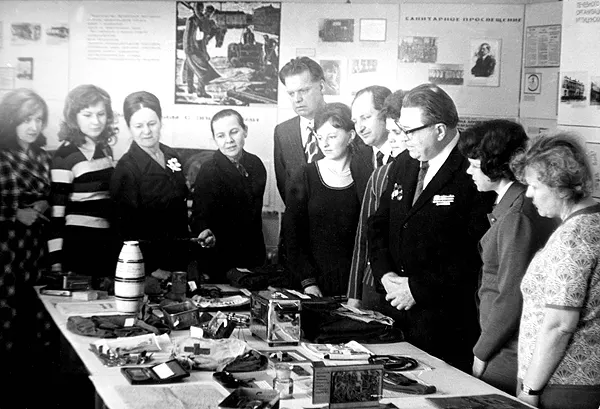
Since 1966 the name of the department «Social Hygiene and Health Care» has been restored.
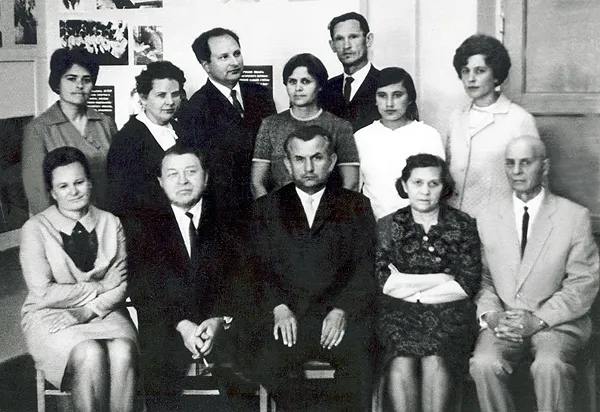
First row (left to right): Shishko Ekaterina Ivanovna, Bialyatsky Dmitry Pavlovich, Kryuchok Grigory Romanovich, Semenova Maria Nikolaevna, Mishchenko Mikhail Maksimovich.
Second row (left to right): Sagalchik Freda Abramovna, Petrova Antonina Fedorovna, Zubritsky Mikhail Kononovich, Eleynikova Valentina Stepanovna, Melnikov Viktor Georgievich, Kuzmich Lyudmila Alekseevna, Zmakhinskaya Nina Fedorovna
The morbidity and mortality of the rural population (V.G. Melnikov, 1965), particularities and causes of perinatal and infant mortality (M.K. Zubritsky), morbidity of workers (M.V. Malkovets, 1975, K.N. Anishenko, E.I. Šiško) were investigated.
In 1976-1980, the first general department topic «The state of children’s health, ways and methods of improving children’s medical care and dispensing in the conditions of a large industrial city» was announced.
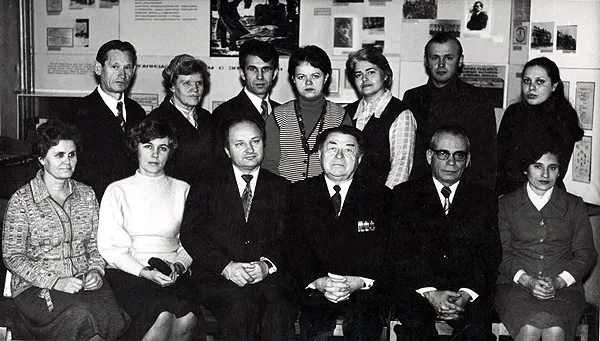
First row (from left to right): Eleynikova Valentina Stepanovna, Zmakhinskaya Nina Fedorovna, Zubritsky Mikhail Konononovich, Beliatsky Dmitry Pavlovich, Anishenko Konstantin Nikolayevich, Kuzmich Lyudmila Alekseevna.
Second row (left to right): Melnikov Viktor Georgievich, Malysheva Margarita Nikolaevna, Shikorsky Valery Petrovich, Malkovec Marina Vladimirovna, Sagalchik Freda Abramovna, Sedy Anatoly Ivanovich, ... Victoria Nikolayevna.
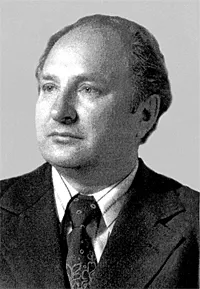
From 1978 to 1995 the Department was headed by the PhD, Assistant Professor Mikhail Konononovich Zubritsky - Professor D. Belyavsky student
He organized and headed the implementation of complex socio-hygienic research at the Department: «Socio-hygienic aspects of diseases of respiratory organs in children», 1981-1985; «Socio-hygienic aspects of diseases of circulatory system in children», 1986-1990; «Medico-social study of lifestyle and health of students of MSMU», 1991-1995.
Assistant Professor K.N. Anishenko, together with Associate Professors I.N. Usov, A.K. Ustinovich, R.E. Mazo, for fundamental research on the protection of children’s health and the reduction of morbidity and infant mortality in the Republic (1969-1984) received the State Prize of the BSSR in the field of science in 1984.
The team participated in sociological research on primary disability of the liquidators of the consequences of the Chernobyl accident (1994).
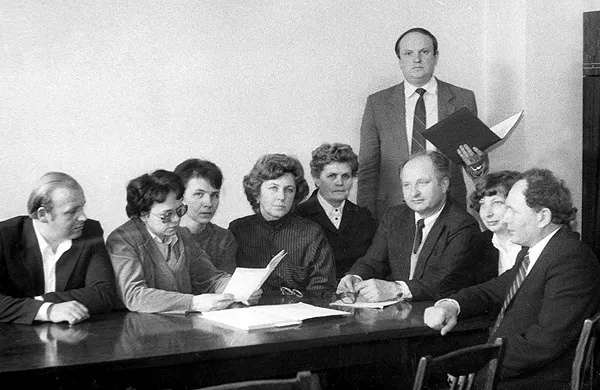
From left to right: Anatoly Ivanovich Sedych, Malkovec Marina Vladimirovna, Zelezynskaya Galina Arkadyevna, Zmachynskaya Nina Fedorovna, Eleynikova Valentina Stepanovna, Filonov Valery Petrovich, Zubritsky Mikhail Kononovich, Kazak Nadezhda Fedorovna, Sudnik Stanin Iosifovich
Under the direction of M.K. Zubritsky at the Department were organized courses «Fundamentals of automated management systems and computer science» (1990), «Economics of health care» (1992), a discipline «Economic theory» (since 1993).
The range of individual independent work of students was expanded.
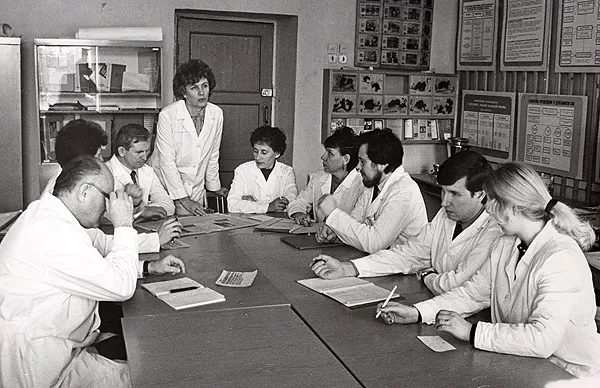
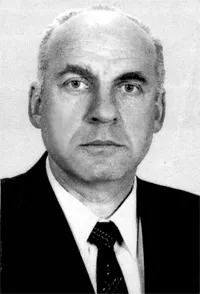
From 1995 to 2010 the department was headed by Dr. Nikolay Nikolayevich Piliptsevich.
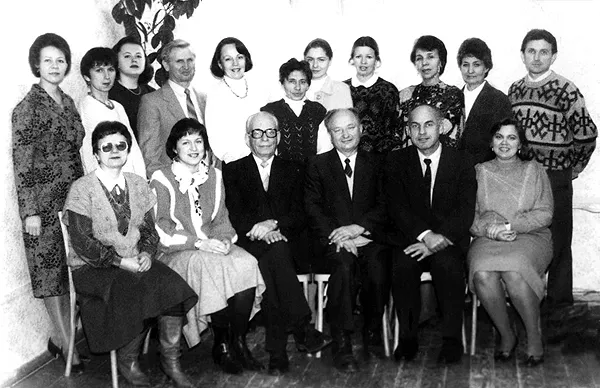
First row (from left to right): Malkovec Marina Vladimirovna, Kulpanovich Olga Alexandrovna, Anishenko Konstantin Nikolayevich, Zubritsky Mikhail Konononovich, Piliptsevich Nikolai Nikolayevich, Mezheva Tatiana Iosifofovna;
Second row (left to right): Plame Lyubov Pavlovna, Moroz Irina Nikolayevna, Zhilinskaya Elena Igozhina, Labzo Stanislav Sergeyevich, Kalinina Tatiana Vlalenovna, Kuzmich Lyudmila Alexeyevna, Dubaleko Anna Ivanovna, Eliseva Ludmila Vladimirovna, Zelesinka Galina Arkadyevna, Radovskaya Inna Evgenyevna, Moroz Vladimir Andreyevich
Since the 1990s the staff of the Department has been actively involved in carrying out scientific research on public health problems, prevention, evaluation of the quality of medical care, management, economy, health care.
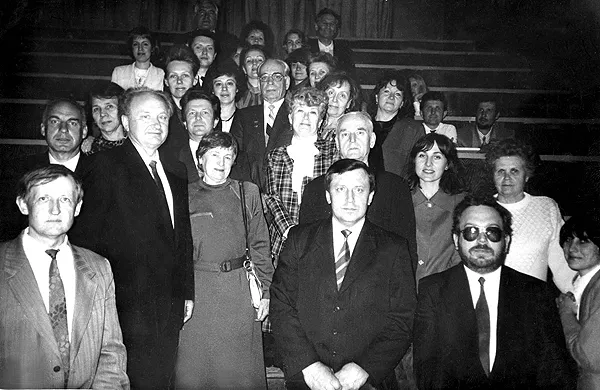
By Ministry of Health Order № 198 of 10.06.2001 the title unification was made as follows discipline, subject and Department names were changed from“Social Hygiene and Public Health” to “PUBLIC HEALTH AND HEALTH CARE”.
Since 2010, Tatiana Petrovna Pavlovich, PhD, Assistant Professoris the Head of the Department of Public Health and Health care (a student of Professor N.N. Piliptsevich).
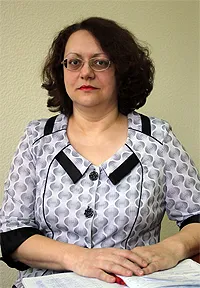
The main directions of scientific research of the staff of the department correspond to the requirements of the time, environment, are socially significant.
Teaching staff of the Department provide consulting assistance to postgraduate students, clinical residents, doctors of practical health care, heads of health-care bodies and organizations on the analysis of the health of population, the activities of health-care organizations, conducting research and statistical data processing.
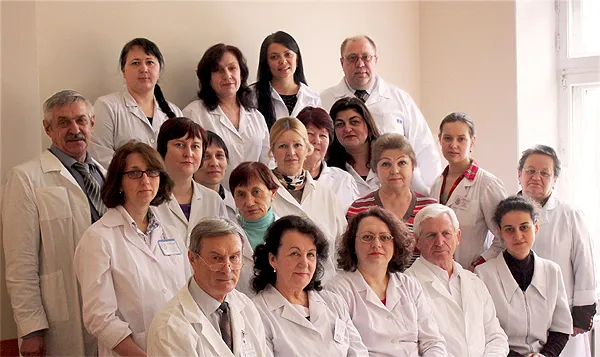
First row (from left to right): Tsybin Alexander Kirillovich, Lazuta Lyudmila Pavlovna, Pavlovich Tatyana Petrovna, Labzo Stanislav Sergeevich, Khalyamina Irina Igorevna
Second row (from left to right): Kunitskaya Svetlana Vasilievna, Ivanova Elena Evgenievna, Shishenok Lilia Viktorovna, Kuzmich Lyudmila Alekseevna, Eliseeva Lyudmila Vladimirovna, Ushakevich Irina Grigorievna, Girko Irina Nikolaevna, Bokun Anna Yakovadlevna, Gulina Maria Nikolaevna
Third row (from left to right): Anischenko Evgeny Konstantinovich, Shapetko Olga Grigorievna, Perkovskaya Alla Fedorovna, Yasinskaya Daria Stanislavovna, Mikhalyuk Sergey Fedorovich
Today the department is a group of professionals-like-minded with a wide field of activity. There is a clear understanding of the challenges ahead in terms of training future health organizers and research.