
«NON-REMOVABLE PROSTHETICS», «REMOVABLE PROSTHETICS», «MAXILLOFACIAL ORTHOPEDICS AND ORTHOPEDIC DENTISTRY»
Мodule «Prosthetic Dentistry», including the following academic disciplines «NON-REMOVABLE PROSTHETICS», «REMOVABLE PROSTHETICS», «MAXILLOFACIAL ORTHOPEDICS AND ORTHOPEDIC DENTISTRY», contains systematized scientific knowledge about the prevention, etiology, pathogenesis and treatment of developmental anomalies, acquired defects, injuries, deformations and functional disorders of the masticatory and other organs of the dental system.
Educational and methodological work is carried out in accordance with the department's work plan. Throughout the academic year, methodological meetings are held to improve the educational process, open classes (twice a year), and individual visits to classes and lectures are improved the methodological skills of the department's faculty.
Since 2014 the Department of Prosthetic Dentistry and Orthodontics has been providing instruction in English for international students of the Faculty of Medicine.
- The following curricula are used when teaching students on english language: NON-REMOVABLE PROSTHETICS. Curriculum of educational institution in the academic discipline for the specialty: 7-07-0911-03 «Dentistry» Reg. # UD-_0911-03-24/2526/edu. 26.06.2025
- REMOVABLE PROSTHETICS. Curriculum of the educational institution in the academic discipline for the specialty: Учебная программа на англ языке учреждения образования по учебной дисциплине для специальности 1-79 01 07 «Dentistry» Reg. # UD-_0911-03-13/2423/edu. 26.06.2024
- MAXILLOFACIAL ORTHOPEDICS AND ORTHOPEDIC DENTISTRY. Reg. # UD-_0911-03-27/2526/edu. 26.06.2025 Curriculum of the educational institution on the academic discipline for the specialty 1-79 01 07 «Dentistry»
The department has developed educational and methodological complexes for students in the following disciplines: "NON-REMOVABLE PROSTHETICS," "REMOVABLE PROSTHETICS," and "MEDICAL OUTPATIENT PRACTICAL TRAINING IN PROSTHODONTICS." An educational and methodological complex for "MAXILLOFACIAL ORTHOPEDICS AND ORTHOPEDIC DENTISTRY" is currently being developed.
«Non-removable Prosthetics» is an academic discipline of the module «Prosthetic Dentistry», containing systematized scientific knowledge about the etiology, pathogenesis, diagnosis, treatment and prevention of anomalies in the development of acquired defects in the crowns of teeth and dentition.
The aim of the discipline «Non-removable Prosthetics» is the formation of specialized competencies for treatment of patients with defects of crowns and dentitions with fixed prostheses.
The objectives of the discipline «Non-removable Prosthetics» are to develop student's scientific knowledge about the etiology, pathogenesis, clinical picture, diagnosis, differential diagnosis, prevention, treatment methods for patients with defects in crowns and dentitions, the skills necessary for: examining patients; making a diagnosis; differential diagnosis; provision of prosthetic dental care to patients with defects in teeth and dentitions with fixed prostheses.
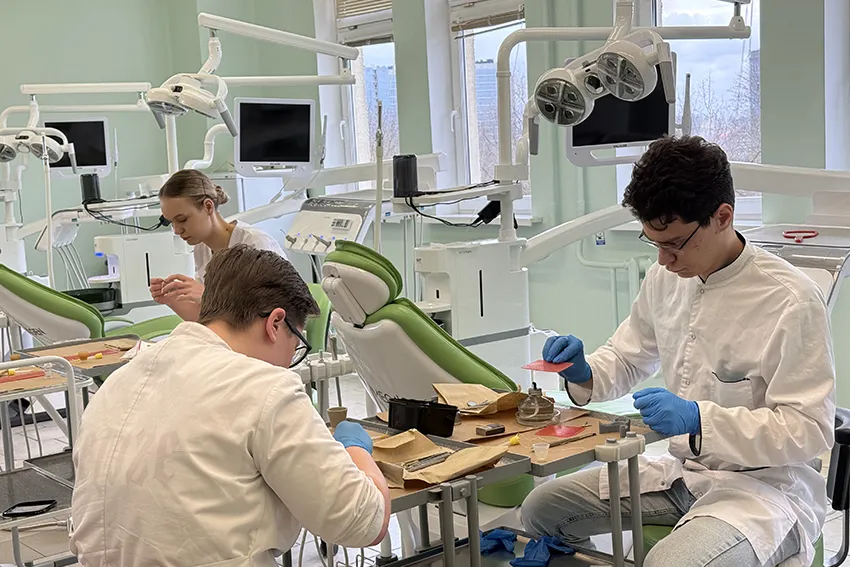
«Removable Prosthetics» is an educational discipline of the «Prosthodontics» module, which encompasses systematic scientific knowledge about the etiology, pathogenesis, diagnosis, treatment, and prevention of congenital and acquired defects of dental arches and complete tooth loss.
The aim of the educational discipline «Removable Prosthetics» is to develop specialized competence for interpersonal and professional interaction, clinical diagnosis, treatment planning for patients, and provision of prosthetic treatment using removable prostheses for patients with defects of dental arches and complete tooth loss.
The objectives of the educational discipline «Removable Prosthetics» include developing students' scientific knowledge about the etiology, pathogenesis, clinical presentation, diagnosis, differential diagnosis, prevention, and treatment methods for patients with defects of dental arches and complete tooth loss. It also aims to develop the necessary skills and abilities for: examining patients; formulating diagnoses; providing prosthetic dental care to patients with defects of dental arches and complete tooth loss using removable prostheses; interpreting results of laboratory and instrumental research methods; selecting prosthesis designs; choosing construction materials; treating patients with edentulism using removable prostheses.
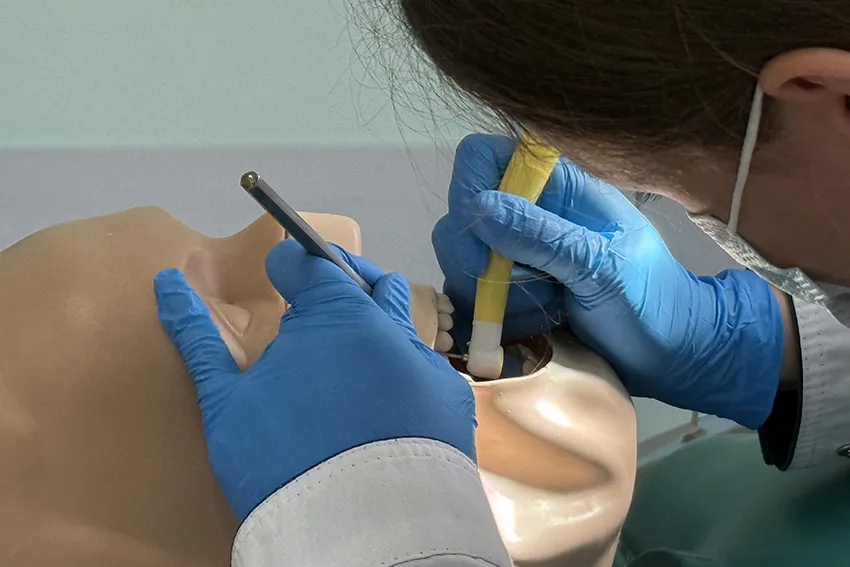
"Maxillofacial orthopedics and orthopedic dentistry" is the academic discipline of the module "Orthopedic dentistry", containing systematized scientific knowledge about prevention, etiology, pathogenesis and treatment of developmental anomalies, acquired defects, injuries, deformations and functional disorders of the masticatory apparatus and other organs of the dental system.
The aim of the academic discipline "Maxillofacial orthopedics and orthopedic dentistry" is to develop the specialized competence for conducting orthopedic treatment of patients with complex maxillofacial pathology at an outpatient admission.
The objectives of the academic discipline "Maxillofacial orthopedics and orthopedic dentistry" are to develop students' scientific knowledge about the etiology, pathogenesis, clinical picture, diagnostics, differential diagnostics, prevention, methods of treating patients with developmental anomalies, acquired defects, injuries, deformities and functional disorders of the masticatory apparatus and other organs of the dental system, the skills and abilities necessary for:
examination of patients; application of diagnostic methods; interpreting the results of laboratory and instrumental research methods; providing orthopedic dental care to patients with a complex maxillofacial pathology; selecting prosthesis designs; choosing construction materials; treating patients with developmental anomalies, acquired defects, injuries, deformations and functional disorders of the masticatory apparatus and other organs of the dental system.
Multimedia presentations of lectures with video material for students, teaching aids, test assignments, and case studies for each practical lesson for students, as well as a test for midterm knowledge assessment and a final test in Russian and English have been developed.
At the beginning of each semester, the department conducts an entrance assessment of students' retained knowledge. At the end of each semester, the rating grade of each student enrolled in the department is calculated.
The intermediate and final forms of assessment of students’ practical skills and knowledge are tests in the 5th, 7th and 10th semesters, differentiated tests in the 9th semester, course exams in the 6th and 8th semesters and the State Examination Commission in prosthodontic dentistry.
After their fourth year, students complete a medical internship in prosthodontic dentistry. A program for internship training is available for students in English. MEDICAL OUTPATIENT PRACTICAL TRAINING CURRICULUM IN PROSTHODONTICS, № УД-L.79-/-7-2-5/2122/mf/p 31/05/2022.
«Orthodontics»
«Orthodontics» is an educational discipline of the Orthodontic Module, containing systematized scientific knowledge about the etiology, clinical manifestations, methods of diagnosis, treatment and prevention of dental anomalies.
The aim of the educational discipline «Orthodontics» is to develop specialized competence to provide medical care to patients with anomalies and deformations of the dental system.
The objectives of the educational discipline «Orthodontics» are to develop in students scientific knowledge about anomalies and deformations of the dental system, methods of their treatment and diagnosis, skills and abilities necessary for:
- patient examinations;
- formulation and substantiation of orthodontic diagnosis;
- drawing up a treatment plan for patients with diseases of the dentoalveolar system during various periods of occlusion formation;
- interpretation of the results of basic and additional research methods;
- choosing the optimal method of treatment or prevention depending on the type of anomaly of the dental system.
The knowledge, abilities and skills acquired in the study of the educational discipline «Orthodontics» are necessary for the successful study of the following academic disciplines: «Maxillofacial Orthopedics and Orthopedic Dentistry», «Oral and Maxillofacial Pediatric Surgery», «Maxillofacial Surgery and Outpatient Maxillofacial Surgery».
A student who has mastered the content of the educational material of the academic discipline should have the following specialized competence: apply diagnostic methods of dental anomalies, instrument, orthopedic and functional methods of treatment in orthodontics, plan the design of orthodontic devices depending on the pathology of the dental system.
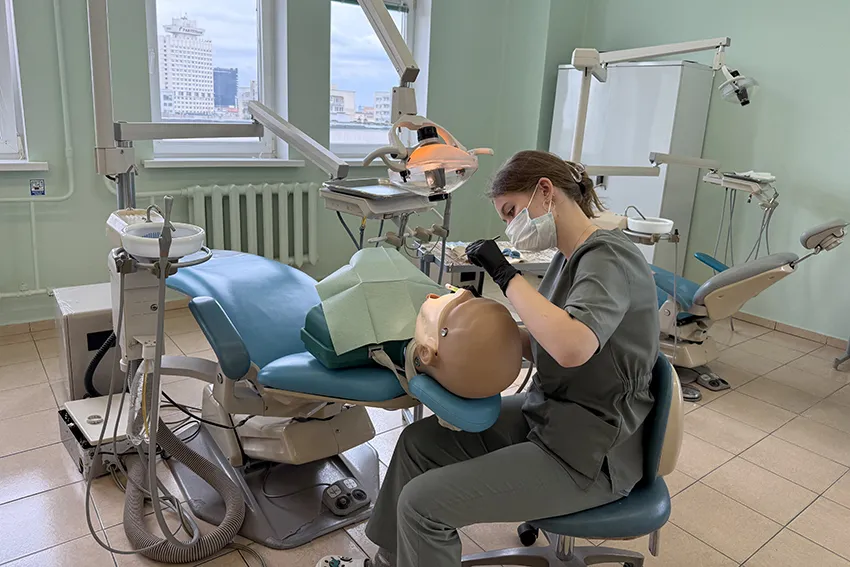
As a result of studying the academic discipline «Orthodontics», the student should
know:
- methods for diagnosing dentofacial anomalies;
- classification of orthodontic appliances;
- principles of design of orthodontic appliances;
- designs of orthodontic appliances depending on the anomaly of the dentofacial system;
- indications for the use of radiation diagnostic methods in orthodontics;
- methods of preventing anomalies of the dental system;
- methods of treating dentofacial anomalies depending on the period of bite formation;
- rules of ethics and deontology;
- requirements of the sanitary and epidemiological regime in outpatient clinics;
be able to:
- plan and conduct communicative interactions with patients and their parents;
- conduct examinations of patients;
- interpret the results of additional examination methods;
- draw up an orthodontic treatment plan;
- predict the effectiveness and duration of treatment;
- organize the workplace of a dentist-orthodontist, taking into account ergonomics and safety precautions, in accordance with the requirements of aseptic and antiseptic rules;
- prepare medical documentation;
- assess the features of the shape and size of the patient’s face with malocclusion;
- take impressions of jaws in children and adolescents, make plaster models, measure diagnostic models of jaws;
- produce clasps, vestibular arches, springs, the basis of a single-jaw orthodontic apparatus;
- use modern methods of treating dentofacial anomalies and evaluate the results of orthodontic treatment;
- determine indications for outpatient surgical interventions;
- provide emergency medical care in acute conditions to children and adults at an orthodontic appointment;
master:
- skills of basic and additional methods for diagnosing dentoalveolar anomalies;
- hardware, orthopedic and functional methods of treating dentoalveolar anomalies;
- methods of preventing dental anomalies;
- technique for taking impressions of a child’s jaws.
When teaching students on English language, the following curriculum is used:
ORTHODONTICS. Curriculum of higher educational |institution in the educational discipline for the specialty: 1-79 01 07 «Dentistry». Reg. UD-0911-03-12/2425/edu.
In the 10th semester, students are taught an elective course in the discipline «INNOVATION IN ORTHODONTICS».
INNOVATION IN ORTHODONTICS. Curriculum of higher educational institution of the elective course for the specialty:1-79 01 07 «Dentistry». Reg. UD-L578/1920/elet.
The elective course "Innovations in Orthodontics" is an in-depth study of the sections of the discipline "Orthodontics", which include modern methods of diagnosis, prevention and treatment of dental anomalies.
The curriculum for the course “Innovations in Orthodontics” is aimed at studying the latest scientific data on orthodontics.
The purpose of the elective course "Innovations in Orthodontics" is to teach students how to prevent, diagnose and treat dental anomalies, control the growth of the jaws, normalize the functions of the dental system, restore aesthetic harmony of the face.
The tasks of studying the elective course are to develop the students’ academic competences, based on the ability to self-search educational and information resources, as well as acquire and understand the knowledge of:
- basic concepts of anthropometric and radiological methods of diagnosis of dental anomalies, modern standard and individual functional orthodontic appliances for the prevention and treatment of dental anomalies, and various types of multibonding systems;
- causes and mechanisms of development of malocclusions;
- the most important manifestations of malocclusions;
- factors influencing the formation of dental anomalies;
The tasks of teaching the discipline include the formation of students’ social, personal and professional competences, based on the knowledge and application of:
- modern anthropometric and radiological methods for the diagnosis of dentofacial anomalies, methods of prevention and treatment of malocclusion, contributing to the formation of clinical thinking in accordance with medical ethics and deontology rules;
- methods for measuring diagnostic models of dentition and lateral cephalograms in periods of mixed and permanent dentition using modern methods;
- Teaching and study of the elective course "Innovations in Orthodontics" is carried out on the basis of the knowledge and skills acquired by the student in the following disciplines of Orthodontics: “Basic of Orthodontics”, “General Orthodontics”, and “Private Orthodontics”.
As a result of studying the elective course "Innovations in Orthodontics" the student must
кnow:
- basic concepts of anthropometric and radiological methods for the diagnosis of dental anomalies, standard and individual functional orthodontic appliances for the prevention and treatment of dental anomalies, various types of multibonding systems, applied microimplants in orthodontics, types of retention and basic retention appliances;
- causes and mechanisms of development of malocclusions;
- the most important manifestations of maloclusions;
- factors influencing the formation of dental anomalies;
be able to:
- to conduct anthropometric and radiological methods for the diagnosis of dental anomalies;
- determine the methods of prevention and treatment of malocclusions;
master:
- to measure diagnostic models of dentition according various methods and lateral cephalograms of the head during periods of mixed and permanent bite;
- to measure diagnostic models of dentition according various methods and lateral cephalograms of the head during periods of mixed and permanent bite;
- The structure of the curriculum for the elective course “Innovations in Orthodontics” includes two sections: “Innovations in Orthodontics”; "Fixed appliances in orthodontics."
Текущая аттестация проводится в соответствии с учебным планом по специальности в форме зачета (10 семестр).
An electronic educational and methodological complex (EEMC) has been developed for the academic discipline “Orthodontics” for the specialty 1-79 01 07 “Dentistry” in Russian and English (Approved at the Meeting of the Scientific and Medical Council on March 19, 2025, Protocol No. 7).