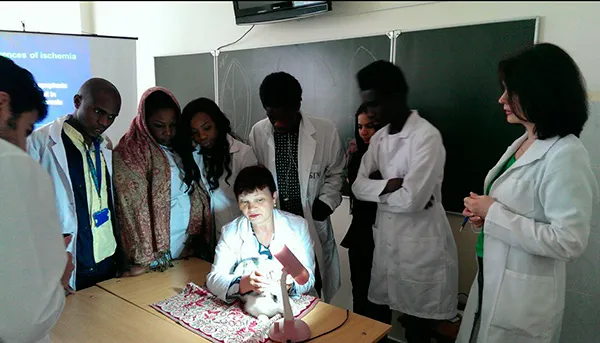
When organizing educational and methodological work, both traditional methods of teaching the discipline (lectures, laboratory classes, controlled independent work of students, intermediate and final control of knowledge) and innovative methods (multimedia lectures, demonstration of video presentations, as well as educational and scientific films in laboratory classes, interactive Internet resources, a computer test system for monitoring students' knowledge are introduced.
When organizing educational and methodological work, both traditional methods of teaching the discipline (lectures, laboratory classes, controlled independent work of students, intermediate and final control of knowledge) are used, and innovative methods are introduced - multimedia lectures, demonstration of video presentations, as well as educational and scientific films in laboratory classes; the use of interactive Internet resources, a computer test system for monitoring students' knowledge.
As a result of studying the discipline, students acquire the following practical skills:
- identification of the main types of cardiac arrhythmias, liver and kidney function according to clinical and additional research methods;
- determination of pathological uniform elements in blood smears;
- conducting pathophysiological analysis of hemograms of patients with various forms of pathology;
- conclusion at hemogram about presence of typical forms of blood system pathology, assessment of severity of the changes that have arisen: judgment on the functional state of the hematopoietic system, its compensatory and adaptive capabilities, the depth and reversibility of the detected deviations; recognize pathological processes in which such changes are possible;
Humanization of teaching process of students is an integral bioethical aspect of teaching the discipline. In this direction, it is extremely important to abandon experiments on laboratory animals in the educational process, to create and use the necessary teaching aids (workshops), computer programs, educational films.
An important factor in the educational process is the involvement of students in educational and scientific research work.
Teaching students in English
According to the Concept for the development of the export of educational services within the framework of cooperation of the Republic of Belarus with foreign states, one of the priorities of state policy is to attract foreign students to our universities for higher education.
Given the current situation on the labor market, more and more foreign citizens prefer training in English.
In many countries, English is either one of the state languages (Nigeria, India, Mauritius), or is widely used as a means of communication in education, business, tourism, etc. (Sri Lanka, Ethiopia, Syria, Iran).
The largest number of students studying in English are students from Iran, Iraq, India, Nigeria, Sri Lanka, Namibia.
Currently, at the Department of Pathological Physiology, the subject is taught in 21 groups of foreign students in English.
Teaching the discipline “Pathological Physiology” in English for foreign citizens in the specialty “General Medicine” is carried out by Associate Professor, Ph.D. Zhadan Svetlana Anatolyevna; Senior Lecturer Pisarik Daria Mikhailovna; Associate Professor, Ph.D. Pereverzeva Elena Vyacheslavovna; Senior Lecturer Chepelev Sergey Nikolaevich.
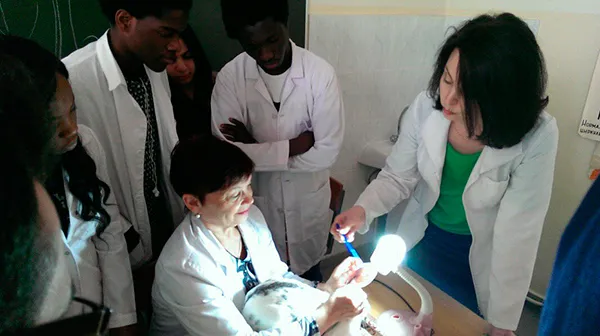
In order to organize the educational process for students of the medical faculty of foreign students at the department, ETMC has been developed for students of the medical, dental and pharmaceutical faculties, where all the necessary educational and methodological literature, presentations of lectures and laboratory classes, teaching and controlling test tasks for laboratory classes are located.
In the foreign literature department of the BSMU library there are textbooks and atlases on the discipline ordered abroad.