Educational and ideological work of Operative Surgery and Topographic Anatomy

September trips of BSMU staff and students

As every year, September 2016 became a source of pleasant impressions and new knowledge about Belarus for a group of our university staff, as well as students and their friends, who gathered together to go on a tour in the direction of the midnight west of our country. The trip was attended by the staff of the Departments of Operative Surgery and Topographic Anatomy, Morphology, Normal Anatomy, Histology and Embryology, Latin, Russian and Belarusian. Our group was accompanied by a very positive guide, Yevgeny, who almost all the way did not stop talking about the sights of our rich history of the region.

First we went to the beautiful old town of Smorgon, where the attention is attracted by the majestic in its simplicity church of St. Michael the Archangel, which was built here in 1503 from wood. Later it was rebuilt into a stone Protestant Calvinist cathedral, then the church returned to the Catholics. Even later, the church housed an Orthodox church,in Soviet times the church was closed and only in 1990 returned to the Catholic faithful.

Next to the church there is a beautiful park with a monument to the «bear Academy», which was founded by the Radziwills. There was in the XVII century. such an educational institution in Europe, where they trained bears, taught them to dance. We saw dancing bears (the sculpture is understandable) and listened to the old, to put it mildly, inhumane methods of their training.

Then we went to Zalesye, where we got acquainted with the life story of the famous Belarusian musician Mikhail Kleofas Oginsky (1765-1833). Michal Kleofas-a descendant of a princely family received a versatile education and made a brilliant career. At the age of 21, he was already a deputy of the Sejm of the Polish-Lithuanian Commonwealth, which at that time was part of our country. In drilling the historical events of that tragic century for our country, he was a participant in the uprising of Tadeusz Kosciuszko, then emigrated. In order to be able to return to his homeland and not lose his property, he was forced to take the oath of allegiance to the Russian Empress. In Zalesie, Michal Kleofas wrote the famous polonaise 'Farewell to the Motherland' which is now associated with his personality. In general, from the works of Mikhail Kleofas, 20 Polonaises, 4 marches, 4 waltzes, 3 mazurkas, a gallop, a minuet, numerous romances, and an opera are known today. The estate in Zalesie, the park and all the surrounding area seem to have passed through the fate of the Oginsky family, which we learned about from the museum staff. By the way, a very interesting and informative story in the museum was presented as if on behalf of those who lived in those days - this is how we met the wife, children, friends of the owner of Zalesya, while all were in costumes of that distant century.

Then we went to see one of the most beautiful churches in Belarus-the Church of the Holy Trinity in the town of Gervyaty - a typical example of the neo-Gothic style. There is a French-style park around the temple, where about two thousand rather rare plants grow, some of which require difficult growing conditions. The park is well maintained with statues of the apostles.

Returning home through Oshmyany, we also got acquainted with this picturesque place.

Indeed, our Belarusian land is very rich in sights, and we hope that we will be lucky enough to see everything with our own eyes again and again.

September Travels

Last Saturday, as every year, a group of employees of the Departments of Operative Surgery and Topographic Anatomy, Human Morphology, Histology, Cytology and Embryology, polyclinic Therapy, together with students and friends who joined us, went on a trip to the picturesque places of our country.

This year, our path was dedicated to the famous Radziwill family, who once owned about a quarter of Belarus. Where did the Radziwill family come from? One of the versions is as follows: Prince Gediminas had a priest, whose name was Lydeika. He explained to Gediminas the dream in which the foundation of the city of Vilnius was predicted. For this advice, the Grand Duke of Lithuania gave Lydike a title, and the descendants began to be called Radziwills.

The main character of the story was Elzbieta Radziwill, who was born in 1917 and now lives in Warsaw. Having marked 101 years, he has a clear mind and a good memory for the events of the past years. We were lucky enough to have an experienced tour guide who knows her personally and has many exclusive photos of the dynasty and knows many stories firsthand. Princess Elzbieta spent her childhood in the Nesvizh Palace, and it can be said that she is the only living Radziwill who lived in the palace as in her residence. And only at the age of 76, she was able to return to her homeland again, to come as a tourist to her once-own palace…

But back to the journey. Our first stop was the church in Ishkoladi. Once these lands belonged to the Radziwills, and it is here that today stands the oldest in Belarus (of the undeveloped) Church of the Holy Trinity (1472). The church impresses with its majestic simplicity and the thickness of the walls, and there is also a log that was used to quickly barricade closed dera in case of sudden attacks. Near the church, the grave of Priest Vincent Loterevich, who died a martyr during the Soviet persecution, defending the faith, has been preserved.

The next town on our way was the village of Polonechka. In this village there is the church of St. George with rich interior decoration, where Ignatius Domeyko was baptized, and where we had the opportunity to climb the choir and see the ancient organ, there were even members of our group who played a few tunes on it. Then the paving stones led us to the palace in the village of Polonechka. The Radziwills built a palace here in the late XVIII-early XIX centuries. Now the building is awaiting restoration, but the impressions of exploring the palace did not leave anyone indifferent.

The next point was the Orthodox church in Volno, built in 1768 as a church, in which the sculptures of angels on the ceiling were preserved from the original interior decoration.

Passing through the village of Stolovichi, we saw the only temple of the Knights of the Order of Malta on the territory of our country.

Next, our path ran through the dreams. There is the church of John the Baptist in 1602, which belonged to the Radziwills. There is also the Rdutovsky Palace, today there is a sanatorium of border guards. By the way, the same Prince Rdutovsky laid the agricultural enterprises, the traditions of which are continued today by the Agrokombinat”Dreams.'

In the village of Bolshaya Lipa, we were struck by the well-preserved sculptures of ricyres decorating the entrance to the former stable where the princely horses stood.

So, listening to the story of the Radziwills, we found ourselves in Nesvizh, which was the capital of the Radziwill princes. We drove through the cozy streets, stopped at the Town Hall, which testified to the receipt of the city of Magdeburg rights. In addition, near the town hall there are preserved shopping malls With a 400-year history, which throughout their existence and to this day have not changed their business-trade.

But the strongest impression is certainly left by the palace and park complex of the XVI-XVIII centuries, built by M. Radziwill 'orphan' according to the project of the Italian architect G. Bernardoni. Listening to our experienced guide, we walked around the majestic Castle-palace with high earthen ramparts and wide moats around the perimeter. It is difficult to imagine that life and those people for whom it was just a home with daily chores and worries. We were lucky enough to honor the memory of some of the rulers of Nesvizh, who now rest in the crypt of the Church of the Body of God.

On the way home, we drove into Novy Sverzhen to see two churches – a Catholic and an Orthodox one, built thanks to Prince Radziwill Sirotk almost at the same time in the XVI century.

Indeed, time flew by quickly, because many things happened to see, hear and even experience. We hope there will be a continuation…

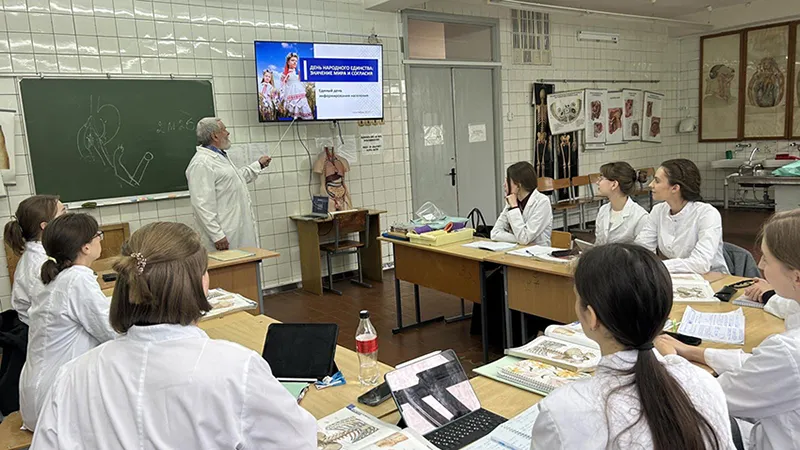
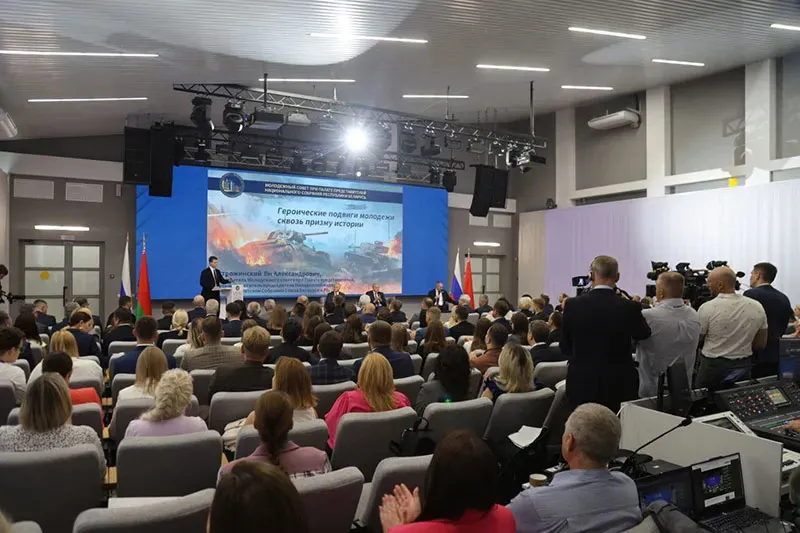
Educational and ideological work at the department is carried out in accordance with the program of educational work of the university and the plan of the department. The purpose of the work is to educate a socially competent, highly professional, creative person.

Curators of study groups regularly meet with students, pay attention to their studies and leisure activities, and periodically visit the dormitories in which they live.

v1.jpg

The most active curators are associate professors Kryzhova E. V., Kovalevich K. M., Klyuj E. A., assistant Prefixer I. V. As part of the educational work, students ' trips together with teachers to historical places of Belarus and Russia are organized.

At the initiative of the curators, assistance is provided to the Minsk City Center for Medical Rehabilitation of Children with Neuropsychiatric Diseases and the nursing care center - psychological support, bandages, etc.

v2.jpg

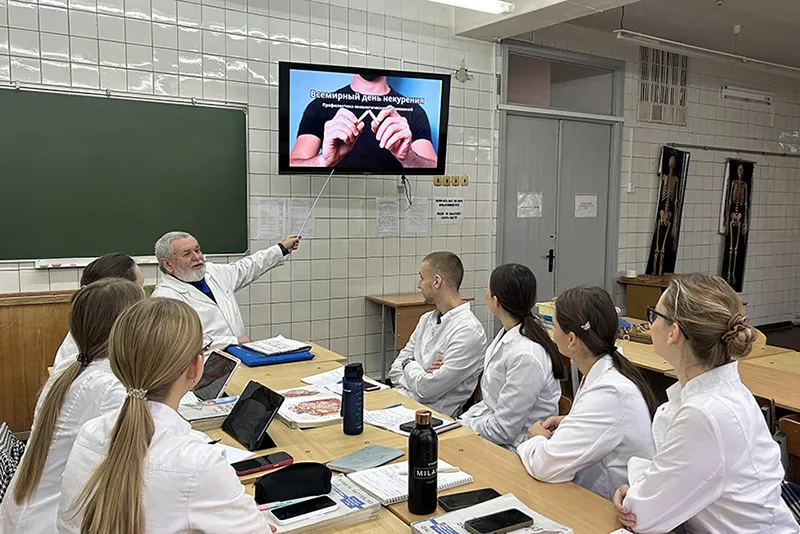
Students of supervised groups take an active part in information and educational work: they give lectures in educational institutions of Minsk on a healthy lifestyle, first aid, rational nutrition, etc.

v3.jpg