
The main directions of research work of the Department of Nervous and Neurosurgical Diseases are cellular biotechnology, telemedicine, photodynamic therapy and local chemotherapy of brain tumors.
New technologies have been developed for autologous stem cell transplantation in multiple sclerosis. Photodynamic therapy using the drug Photolon and treatment of neuroepithelial brain tumors using local chemotherapy have been introduced. A method for predicting the outcome of thrombolytic therapy in patients with cerebral infarction has been developed.
More than 150 transplantations performed in cooperation with the State Institution «Minsk Scientific and Practical Center for Surgery, Hematology and Transplantology». The work is carried out as a part of an international project of the European Group on Blood and Bone Marrow Transplantation (EBMT). The effectiveness of remyelination in co-transplantation of mesenchymal and hematopoietic stem cells was studied on the model of experimental autoimmune encephalomyelitis. There are a number of presentations at international forums and publications in leading scientific journals on the use of stem cells in patients with multiple sclerosis.
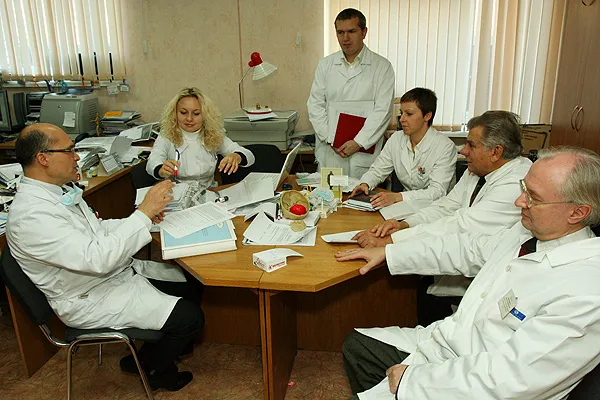
The clinical, social and economic efficacy of autologous stem cell transplantation in multiple sclerosis has been confirmed. The effectiveness of the transplantation course of autologous mesenchymal stem cells in this disease has been proven for the first time. This fundamentally new results secured priorities of the Republic of Belarus in the field of cell therapy of multiple sclerosis.
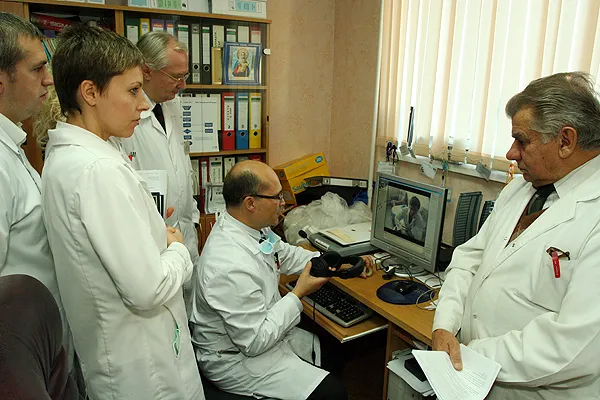
One of the areas of scientific activity of our structural unit is telemedicine. The staff of the department participated in the creation of a complex for telemedicine consultations, which is successfully used in the provision of medical care at one of the largest industrial enterprises of the Republic of Belarus, and a portable telemedicine complex. The developed telemedicine complex was presented at the annual specialized exhibition «Medicine».
Since the 70s of the 20th century, under the leadership of Academician N.Misyuk, the department began to work on the creation of systems for predicting neurological diseases. A number of prediction systems have been created, including topics: acute disorders of cerebral circulation, neurological manifestations of osteochondrosis of the spine, pulmonary embolism, the severity of clinical manifestations of polyneuropathy, the need for manual therapy in lumbosacral osteochondrosis, etc.
A certificate of the Federal Service for Intellectual Property, Patents and Trademarks of the Russian Federation on the official registration of the expert system for predicting strokes were obtained. There are patent applications and rationalization proposals for a number of programs for predicting various neurological pathologies. The expert system for predicting strokes has been introduced and is successfully operating in health care institutions in Minsk, Brest and Vitebsk regions. Systems for predicting acute cerebrovascular accidents in young people, the onset and early diagnosis, the severity of the course and the immediate outcomes of neurological manifestations of osteochondrosis of the spine have been developed.
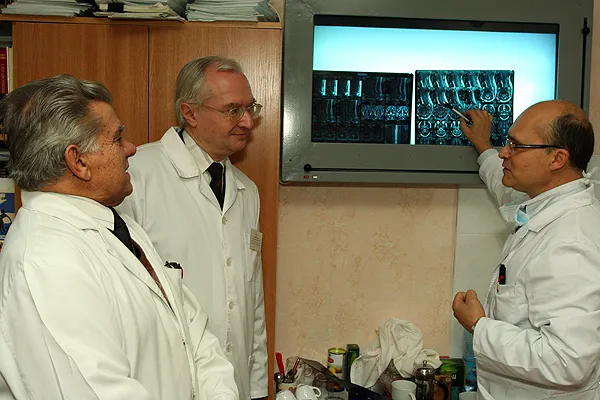
The staff of the department is conducting research to expand the possibilities of the laser usage in neurooncology. Clinical trials of the domestic diode laser surgical apparatus «DIOLAZ-810» have been carried out, the test results have been introduced into practice. A technology for the treatment of patients with primary cerebral infiltrative and metastatic brain tumors has been developed on the basis of laser photodynamic therapy, that is using the domestic second-generation photosensitizer Photolon.
The innovative project «Technology of minimally invasive endoscopic treatment of patients with hernias of the disc of lumbo-sacral spine», proposed by the department staff, took part in the Republican competition GKNT-2015 and became a winner of the competition as part of the seminar «Spinal neurosurgery» in Salzburg in 2018. In addition to the positive clinical effect, endoscopic technology makes it possible to visualize all the stages of the operation for students, clinical residents, young doctors, which raises the learning process to a whole new level.
A minimally invasive reduction and external immobilization of fragments of depressed fragmented fractures of the frontal sinus, which has no analogues in Belarus and abroad, has been developed and implemented. High functional and cosmetic efficiency of the technology has been proven for traumatic injuries, which is within the scope of interests of both ENT doctors and neurosurgeons.
New technologies of cranioplasty operations for injuries and diseases of the skull bones are being developed. An innovative technology of skull defect plastics with a patch made of polymethyl methacrylate, made on the basis of individual computer 3D modeling, was developed together with the staff of the neurosurgical department. A system of titanium craniofixers is introduced to fix the prepared patches.