
The history of teaching urology as an independent discipline at the Minsk State Medical Institute begins in February 1967, when the Department of Urology was opened by the decision of the administration. The clinical base of the department has become a 60-bed urological department in the 4th city clinical hospital in Minsk.
The head of the department and its organizer was a well-known urologist and health care organizer, Doctor of Medical Sciences, Professor Nikolai Evseevich Savchenko.
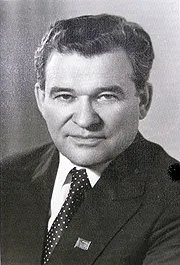
Savchenko N.E. was born in the Chechersk district of the Gomel region in 1922. In 1938 he entered the medical faculty of the Moscow State Medical Institute. From the first day of the Great Patriotic War, he volunteered for the front and as a scout, and then paramedic of a reconnaissance battalion of a tank corps, reached Prague. He was awarded three military orders and many medals.
After returning to Minsk in 1958, Nikolai Savchenko continued to work as an associate professor at the Department of Urology at the Belarusian State Institute for Advanced Medical Studies. In 1960, he was appointed rector of this institute, and at the end of 1966 - the Minister of Health of the Republic.
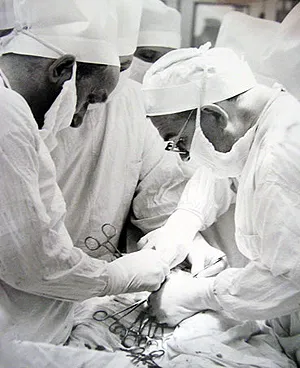
In 1965 he defended his doctoral dissertation on the topic «Hypospadias: Fragments of Theory, Pathogenesis», in 1966 he was awarded the academic title of professor.
The first employees of the department, along with N.E.Savchenko, were PhD, Associate Professor V.A. Mohort and PhD, Assistant Plisan S.O.
Before joining the department, Vyacheslav Andreevich Mokhort worked from 1958 to 1961 as an assistant at the department of urology at Belarusian Institute for Advanced Training of Doctors, and from 1961-1967 as head of the urology course at the Grodno State Medical Institute. In 1960 he defended his PhD thesis on the topic «Actinomycosis of the genitourinary organs».
In 1968 he defended his doctoral dissertation «Materials of experimental and clinical research on the reinnervation of the bladder», and in 1969 he was awarded the title of professor. His scientific and practical activities are multifaceted and devoted to many areas of urology.
Under his leadership and for all the years of work in different universities, 3 doctoral and 12 PhD theses have been defended, he is the author of 230 scientific papers. He was awarded the honorary title «Honored Scientist of the Republic of Belarus».
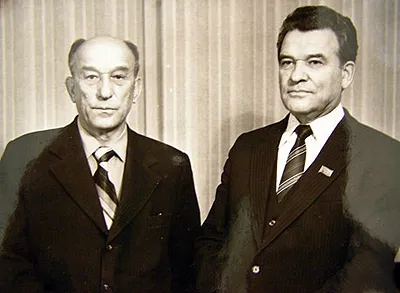
Slava Oskarovna Plisan, after defending the dissertation «Dispensary examination of patients after adenomectomy in the light of immediate and long-term results of treatment» in 1965 for the degree of PhD, worked as an assistant at the Department of Faculty Surgery of the Moscow State Medical Institute. For 15 years at the Department of Urology, Slava Plisan was the assistant to the head of the department for academic work. She is the author of 80 scientific papers, one monograph. For 12 years she was the secretary of the Republican Society of Urology.
Subsequently, for the development and introduction into clinical practice of a new method of surgical treatment of neurogenic urinary disorders - ileovesicopexy of Professor N.E. Savchenko and V.A. Mohort were awarded gold and silver medals (respectively) of the Exhibition of Economic Achievements of the USSR - the most prestigious competition in science and other areas of the Soviet Union.
Since 1967, the department has annually held competitive admission to clinical residency in 2 specialties: urology and nephrology. The first clinical residents of the department in 1967 were Gres A.A. and in 1968 – A.E. Budrevich.
In 1969, Professor N.E. Savchenko elected a Corresponding Member of the Academy of Sciences of the BSSR. Despite the fact that the department headed by him was called the Department of Urology, Nikolai Savchenko was constantly interested in and dealt with issues related to the discipline of urology - nephrology. By that period, nephrology in Belarus was not isolated as an independent specialty. In this regard, in 1970, on the initiative of Nikolai Savchenko, the first in the Republic nephrology department with 40 beds and a programmed hemodialysis laboratory were opened as part of the clinical base of the department, and the clinic itself received the status of the Republican Center of Urology and Nephrology. This was the prologue for the subsequent formation of the kidney transplantation service. The first kidney transplant operation in Belarus by Professor N.E. Savchenko and V.A. Mohort performed on September 11, 1970. Later, in 1971, a scientific laboratory for kidney transplantation was organized at the department (head – G.T. Kozlov). The first researchers of the laboratory Pilotovich V.S., Soklakov V.I., Skobeyus I.A., in addition to research work, took upon themselves the whole range of issues related to providing assistance to this difficult category of patients.
In 1971, as part of the kidney transplant laboratory, a new direction of surgical nephrology was organized in Belarus - the surgical treatment of symptomatic renal hypertension. Nikolai Savchenko and employees of this group headed by V.P. Krylov performed and introduced into practice the whole range of operations for renovascular hypertension and received good results. The opening of the nephrology department and the kidney transplant laboratory has significantly improved the opportunities for teaching urology and certain issues of nephrology at the department.
In 1971, associate Professor Zinaida Aleksandrovna Trofimova was elected to the post of head of department. From the first weeks of her work in the new clinic, she proved herself to be an excellent clinician and surgeon, a wonderful person who was completely devoted to the department and patients. In 1972, Savchenko N.E. Elected as a full member of the Academy of Sciences of the BSSR, and since 1971 - Chairman of the Board of the Belarusian Scientific Society of Urologists.

As part of the clinic, a children's urology department was opened, the nephrology department was expanded to 60 beds, and the kidney transplant laboratory received 10 inpatient beds for the treatment of specialized patients. Thus, the bed capacity of the clinical base of the department was 170 beds.
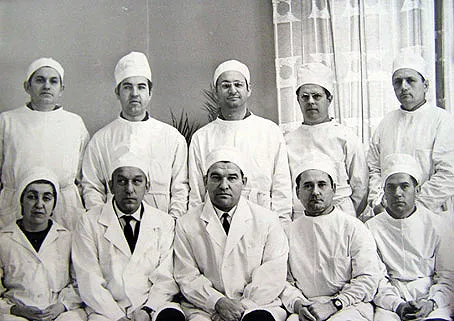
In 1981, Skobejus Izaokas Andreevich, who previously worked as a senior researcher at the kidney transplant laboratory, was elected to the position of assistant (since 1986, associate professor) of the department. With his arrival, the level of highly qualified urological care for children and endourological care for adults has noticeably increased. For the first time in the practice of pediatric urology in the USSR, he introduced kidney autotransplantation for severe defects of the upper urinary tract and obtained good immediate and long-term results. Under his leadership, the Republican Center for Pediatric Urology was subsequently organized.
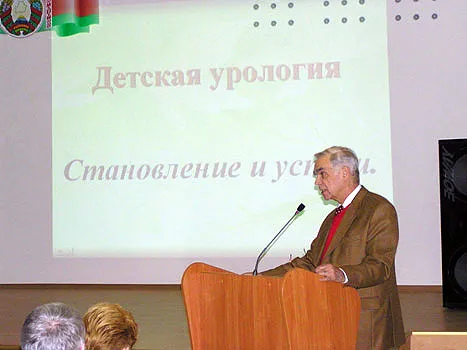
As recognition and confirmation of the merits of the Belarusian School of Urologists and Nephrologists, by decision of the USSR Ministry of Health, the first All-Union Congress of Nephrologists was held in Minsk in 1974, and in 1984 - the Third All-Union Congress of Urologists.
In 1983, the urological and nephrological departments of the hospital and the department of urology of the Minsk State Medical Institute moved to a new building, equipped with the most modern equipment at that time. For the teachers of the department, the presence of such a powerful center of urology and nephrology made it possible to create conditions for students to gain a wide range of knowledge and knowledge on the etiopathogenesis and diagnosis of diseases of the genitourinary system and the latest methods of conservative and surgical treatment of profile patients.
At that time, the Republican Center for Urology and Nephrology became one of the largest scientific, practical and pedagogical specialized centers of the Soviet Union, and for a number of problems (treatment of neurogenic urinary disorders, hypospadias, epispadias) - the head one. Its uniqueness lay in the fact that for the first time within the framework of a single clinic, it was possible to collect all the services that were engaged in the diagnosis and treatment of urological and nephrological diseases from childbirth to old age. From all regions of the Soviet Union and even from abroad, doctors constantly came to the clinic for on-the-job training in selected sections of urology, the enrollment for clinical residency was constantly increasing. In particular, clinical residency was very popular among young doctors from foreign countries: Lebanon, the Dominican Republic, Palestine, Jordan, Kuwait, Niger, Mali, El Salvador, etc.
On June 11, 2001, not having lived a little over a year before his 80th birthday, the head of the clinic, Professor N.E. Savchenko, died of a heart attack. In 2001, at the request of the employees of the 4th City Clinical Hospital and the administration of the BSMU, by decision of the Council of Ministers of the Republic, 4th City Clinical Hospital was named after N.E. Savchenko, and the scholarship named after academician N.E.Savchenko was approved at the BSMU.
Since 2003, Doctor of Medical Sciences, Professor A.V. Strotsky, who had previously worked as a professor at the Department of Urology and Nephrology at Belarusian Medical Academy of Postgraduate Education, was elected to the post of head of the newly organized Department of Urology, Anesthesiology and Reanimatology.
With his arrival at the urology clinic of the Belarusian State Medical University, research work was noticeably intensified, and the technical re-equipment of urological departments began. In 2008, by the decision of the administration of the BSMU, the Department of Urology was restored with a staff of 5 teachers, headed by Professor A.V. Strotsky. The positions of associate professors of the department were occupied by the experienced Skobeyus I.A., Yushko E.I., Rudenko D.N., and Gavrusev A.A., PhD was enrolled in the vacant positions of assistants in the competition and Raguzin A.A. The main scientific problems of the department in recent years: the development of new treatment regimens for children with megaureter, hypospadias, neurogenic disorders of urination, urinary tract infections, injuries of the organs of the urological sphere. The staff of the department and clinic constantly take part in conferences, symposia, congresses, congresses in our country and abroad. Close scientific contacts exist with the Polish Society of Urology, Research Institute of Urology in Russia and Ukraine.
Since 1967, 6 doctors and 24 candidates of medical sciences have been trained at the Department of Urology, more than 900 scientific papers have been published. Over the years, more than 65 doctors from Belarus and 45 doctors from far abroad have completed their clinical residency in urology and nephrology.
For the first time in the history of the department, elective cycles have been introduced into the pedagogical process for clinical residents: urogynecology, pediatric urology, geriatric urology, endourology. The staff of the Department of Urology identify themselves as representatives of the outstanding, recognized in the urological world of the Russian scho