Educational and methodical work is one of the main sections of the department's work. The deputy head of the department for educational and methodological work in the 2025-2026 academic year is the senior teacher Kachur Svetlana Leonidovna.
When planning educational and methodological work, the staff of the department is guided by the Model curricula for higher educational institutions in the following specialties: 7-07-0911-01 « General medicine», 7-07-0911-06 « Pediatrics», 7-07-0911-03 « Dentistry» approved in 2025. In accordance with the Standard Curriculum, the department has drawn up working curricula, which are reviewed and approved annually.
Planning of work and distribution of the workload at the department is carried out in accordance with the curriculum and job responsibilities of the staff.
The developed and approved methodological recommendations are used, taking into account the standard programs for teachers - in radiation diagnostics and radiation therapy - for all faculties.
Methodological guidelines are used for students of all faculties, taking into account the current standard programs - in radiation diagnostics and radiation therapy.
The current control of educational and methodological work is carried out by the head of the department and the deputy head. Department of Academic Affairs, as well as deans and vice-rectors of the university. The progress and attendance of lectures and practical classes by students is constantly monitored. The issues of academic performance, rating and academic discipline of students are discussed at the meetings of the department in accordance with the work plan of the department with subsequent information from the deans.
The discipline “Radiation diagnostics and radiation therapy” includes sections:
- radiation therapy
- radiology
- radionuclide diagnostics
The main forms of training are:
- lectures,
- practical training,
- systematic computer control of knowledge (tranning and final),
- extracurricular independent work of students.
- Lectures - on all topics are conducted in multimedia format.
Workshops
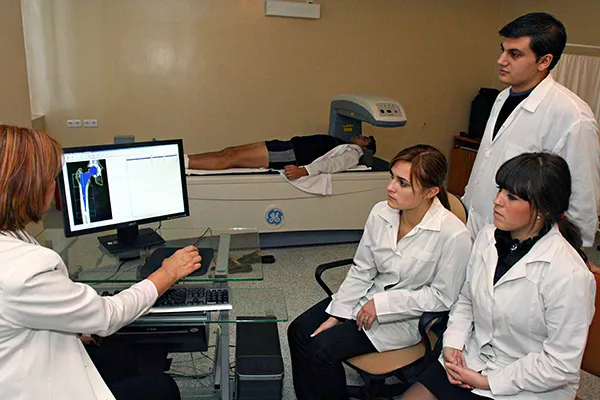
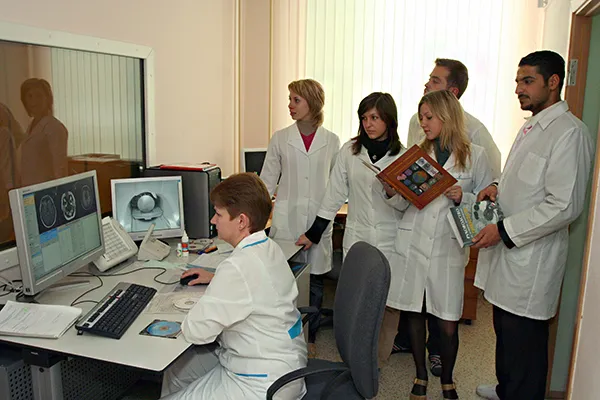
The basis of the educational process at the department is the visibility of teaching. To solve this problem, all teachers have created and are constantly updating thematic sets of educational radiographs, data from radioisotope studies, ultrasound, CT and MRI studies, supplemented by clinical indicators.
For the first time in the Republic of Belarus, a specialized database has been created for students of the Faculty of Dentistry, covering almost all topics of radiation diagnostics in dentistry, which also provides for independent work of students with illustrations on the following topics:
- Methods of X-ray examination used in dentistry.
- X-ray anatomy of the maxillofacial region. Age and functional options for the structure of teeth and jaws.
- X-ray diagnostics of traumatic injuries of the maxillofacial region.
- Radiation diagnosis of inflammatory diseases of the maxillofacial region.
- Radiation diagnosis of cysts and tumors of the maxillofacial region.
- Radiation diagnosis of diseases of the salivary glands.
In practical classes, teaching materials prepared by teachers are used, such as:
- situational tasks for radiation diagnosis of the osteoarticular apparatus, respiratory organs, etc., for drawing up a radiation therapy plan;
- Learning Control Description Protocols - Chest X-rays; bones and joints;
- case history of patients receiving radiation therapy;
- sketches of cross sections of the body for calculating doses.
Students get acquainted with the work of X-ray diagnostic rooms, radioisotope laboratory, X-ray therapy room. Independently, with the participation of a teacher, they work in classrooms, getting acquainted with the results of research, sets of educational materials, according to which the norm and pathological changes are differentiated. When studying the basics of radiation therapy, students analyze educational case histories and radiation protocols with the teacher, consider the tasks of determining the indications and choosing the method of radiation therapy.
A test base has been developed for the current control of knowledge. Materials for preparation for intermediate control of knowledge are posted in http://etest.bsmu.by/.
The computer program also provides for the completion of missed practical classes on all topics of radiation diagnostics and radiation therapy. For independent work of students, radiographs, ultrasound, CT and other data on all topics were introduced into the computer program.
Extracurricular independent work consists in the fact that in the process of independent home preparation for the next lesson, students get acquainted with the lecture material, sections from tutorials and manuals, prepare graphic sketches of the X-ray image, reflecting the understanding of the spatial location of various organs and the pathological substrate.
Students are actively involved in educational research work. This form of training includes the preparation by students of abstract messages on the most relevant topics, as well as the preparation of student research papers that students can present at the annual student scientific and practical conference.
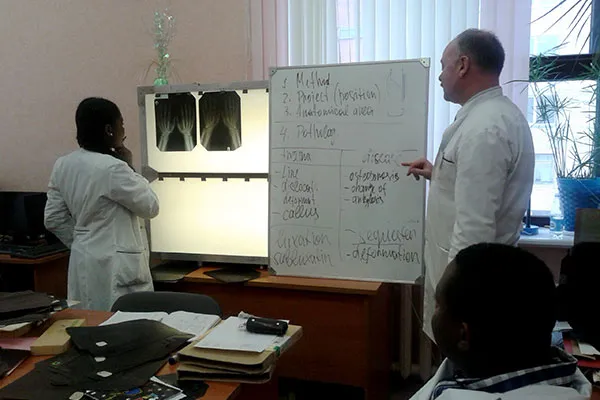
In accordance with the work program, the department is integrating the subject on certain issues of radiation diagnostics and radiation therapy with other departments: physics, normal anatomy, physiology, surgical and internal diseases, maxillofacial surgery, etc.
The current certification in the discipline “Radiation Diagnostics and Radiation Therapy” for 3rd year students of the medical, pediatric faculties is carried out in the form of a differential credit, for students of the dental faculty in the form of a credit.
The staff of the department performs a large amount of methodological work. Since 2017, students can prepare for practical classes using the materials of the textbook on radiation diagnostics and radiation therapy, the authors of which are the teachers of the department.
Training of clinical residents
The department annually carries out two-year (full-time) and three-year (full-time and part-time) forms of training specialists in radiation diagnostics through clinical residency.
The theoretical section includes a cycle of lectures on radiation diagnostics and seminars on the main sections of radiation diagnostics.
Practical training is carried out at the bases of specialized clinics and the Republican Scientific and Practical Center of Minsk. In the course of training, clinical residents master traditional and modern radiation research methods (CT, MRI, angiography, etc.).