
Purpose:the formation of a comprehensively developed, socially competent personality with an active life position.
Tasks:
- Preparation for independent life and professional activity.
- Formation of civic qualities, moral and aesthetic culture and healthy lifestyle skills.
- Creation of conditions for self-development and self-realization of the individual.
The department carries out work and activities aimed at the formation of students' active life position, moral and ethical criteria in the personal aspect, national identity and culture. Each teacher spent weekly information hours in groups of practical classes at the department.
The department conducts uniform days of informing and conversations according to the plan, as well as information and educational hours: electoral rights of citizens, information culture of the individual, public order and culture of the individual, familiarity with regulatory documents is carried out. Samokhval O.V., Yurchik K.V. held conferences on the topic “What is domestic violence?” Bylinsky N.N., Volkova O.N. Legal formation of civil competence Anti-corruption policy in the Republic of Belarus. Public order and culture of the individual. In order to form an ethical culture, moral and family education, all teachers took part in events dedicated to Mother's Day (together with the 10th City Children's Clinic) for the formation of civic competence, patriotism VV Yushko, VV Dmitrachkov. spent information and educational hours: electoral rights of citizens of the Republic of Belarus, outstanding people of Belarus. All preachers took part in holding common Days of Health, talks about healthy lifestyles on the developed topics of developing a culture of healthy lifestyles and safe living, participated in a round table dedicated to the International AIDS Day.
Educational work with students is reflected in the diaries of the curators, as well as in the logbook of the events held. Curators' diaries contain thematic planning of curatorial hours, plans for educational work for the year, personal data of students, information on student progress, reports of curators on the work done.
During the academic year, it was spent in supervised groups: 16 information hours, 6 educational hours. When carrying out educational work, the curators of the department used information materials that were provided by the department of educational work of the university and the deputy dean for educational work of the pediatric faculty.
All curators of the department carried out in their supervised groups work with students - in order to assist in the development of the curriculum in the subject. This work is reflected in the plans of the curators and their journals.
In the main planned areas of educational work during the second half of 2019, the following was completed: ideological and civil-patriotic education - 100%; spiritual and moral, family and gender education - 90.3%; legal education and preventive work - 100%; labor, environmental and professional education - 100%; education of healthy lifestyle culture - 100%; upbringing of a culture of everyday life and leisure, aesthetic upbringing - 90%; organizational and methodical work - 100%.
Description of the work performed
During the second half of 2019, the greatest attention was paid to the following areas of educational work: ideological and moral and legal (2 events), the formation of a healthy lifestyle (2 events), fostering a culture of professional activity (2 events).
In educational work with students, various forms and methods were used: individual and group conversations, interactive seminars and round tables, much attention was paid to the rallying of student groups, the development of professional abilities, visits to cultural institutions of the city were organized.
During the curatorial hours, issues of current academic performance and attendance were discussed, sufficient attention was paid to promoting a healthy lifestyle. Particular attention was paid to the students living in the hostel. In order to check living conditions, clarify housing and household problems, the curators visited the student hostel in accordance with the schedule and as needed (hostel No. 10).
Ideological and civil-patriotic education
- Organizational meetings with students of supervised groups.
- Updating social passports of groups, their analysis.
- Studying the material conditions of life and everyday life of students, identifying their interests, hobbies.
- Excursion to the Great Patriotic War Museum (November 2019) with students of group number 2310.
- Meeting with labor veteran Volkov I.N. (November 2019) with students in 2306 and 2308 groups.
Moral, family and gender education
- Coverage of moral and aesthetic issues at seminars, coverage of the ethics of a pediatrician and pediatric deontology.
- Familiarization of students with the moral and ethical code of the BSMU student, order No. 466 groups (in supervised groups).
- Participation in events dedicated to Mother's Day together with 10 city children's polyclinic (October 2019)
Legal education and preventive work
Round table “Domestic violence” (December 2019) together with group number 2313.
Rights and obligations of students, culture of behavior in hostels, educational institutions, public places. Prevention of the facts of antisocial behavior (during the second half of the year).
Visiting rooms of students of 10 hostels by curators (during the II half of the year).
Familiarization with the normative documents “Regulations on the hostel”, “University Charter”, the Code on education in supervised groups (September-October 2019).
Labor, environmental and professional education
Participation in New Year's parties for patients “4th City Children's Clinic” (December 2019) together with groups 2303, 2307.
Raising a healthy lifestyle culture
Seminars on the prevention of bad habits “Beware of spice”, “Myths about smoking”, “Health risks in a sedentary lifestyle” (December 2019) together with students of 2306 and 2310 groups.
Conversations with patients “4th City Children's Clinic” on the promotion of a healthy lifestyle, hygienic training and education (during the second half of the year).
Education of a culture of everyday life and leisure, aesthetic education
Conversations with students about the culture of living in a hostel (during the second half of the year).
Supervision of rooms for students in the 10th dormitory (during the second half of the year).
Information hour dedicated to anti-corruption policy in the Republic of Belarus.
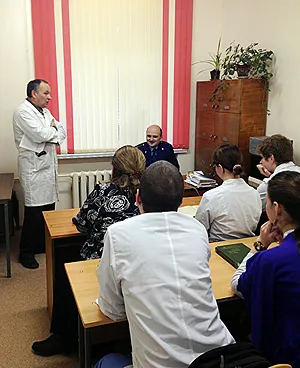
On December 4, an information hour dedicated to anti-corruption policy in the Republic of Belarus took place at the Department of Propedeutics of Childhood Diseases in group 353 of the Pediatric Faculty, supervised by assistant N. Bylinskiy.
The students got acquainted with the main legislative acts, discussed the urgency of the problem of corruption in the healthcare sector. The senior assistant to the prosecutor of the Zavodskoy district of Minsk, Kazei Vadim Anatolyevich, was invited to participate in this event, who explained the concepts of the terms “corruption”, “bribe”.
Students took an active part in discussing the problem of bribery in medicine, sifted through situational examples with interest, and asked questions to the invited guest.
Educational work is carried out under the leadership of the department of educational work with youth and the dean's office of the pediatric faculty.
The teachers of the department also carry out sanitary and educational work: appearances in the media, printing articles in popular science magazines about health.
The task of the curators is the formation of a comprehensively developed, morally mature personality, assistance to the professional development of students for subsequent self-realization in educational and professional activities. For this purpose, information and educational hours are held, conversations on topics of medical ethics and deontology, on the rules of conduct at the department and in the clinic. Seminars are held on the formation of a healthy lifestyle within the framework of the uniform Days of Health in accordance with the plan of the university. Curators pay attention to discipline issues, analyze the academic performance of students in a curatorial group.
Curators take part in conferences, seminars, as well as organizational sessions for curators, take advanced training courses at the Republican Institute of Higher Education.